GENE AMPLIFICATION (PCR) :
Gene amplification is obtaining multiple copies of a known DNA sequence that contains a gene.
Gene ampliication can be done artificially, by using polymerase chain reaction (PCR) technique.
Thus PCR is in vitro technique of gene amplification.
It is a scientiic technique in molecular biology used to generate billions of copies of a particular DNA sequence in short time.
It was first developed in 1983 by Kary Mullis.
In 1993, Mullis was awarded the Nobel Prize in Chemistry for this work.
Basic requirements for PCR technique
1. A DNA segment (100-35,000 bp in length) to be amplfiied.
2. Primers (forward and reverse) are
- synthetic oligonucleotides of 17-30 nucleotides.
- complementary to the sequences present on the desired DNA segment.
3. Four types of deoxyribonucleotides (dATP, dCTP, dGTP, dTTP). They are collectively called dNTPs.
4. A thermostable DNA polymerase, that can withstand upto 94°C. Usually Taq polymerase isolated from bacterium Thermus aquaticus is used.
The vast majoity of PCR methods use thermal cycling, i.e., alternately heating and cooling the PCR sample.
Three essential steps of PCR technique
1. Heat denaturation:
This step involves heating of DNA at about 91°C.
The heating breaks the hydrogen bonds to make ssDNA.
The DNA molecule with more G-C pairs, need higher temperature.
2. Annealing:
It is pairing of primers to the ssDNA segment.
The primers have to be designed as per the requirement.
This step requires temperature at about 55°C
3. Polymerisation:
The temperature is raised to 72°C.
The Taq polymerase adds dNTPs behind the primer on the ssDNA.
Process of PCR
The three steps constitute one cycle of the reaction.
The process is carried out for about 28 -30 cycles beyond which its reliability decreases.
Each cycle of PCR takes about 3-5 minutes.
As PCR progresses, the DNA generated is itself used as a template for replication, thus setting a chain reaction in which the DNA template is exponentially amplified.
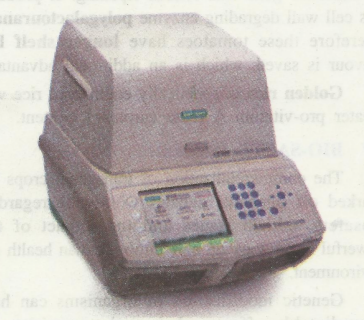
PCR is carried out on an automated machine.
Application of PCR
PCR technique is used in medical and biological research labs for a variety of applications.
1. DNA cloning,
2. gene amplification,
3. DNA-based phylogeny,
4. Functional analysis of genes,
5. Diagnosis of hereditary diseases,
6. DNA fingerprinting (used in forensic sciences and paternity testing),
7. Detection and diagnosis of infectious diseases and
8. Diagnosis of cancer.
