1. Collection of Variability:-
Variations are the differences seen among individuals of a species or population, for a particular character.
Such genetic variations are heritable and are useful in selection.
In many crops genetic variations are available as pre-existing characters in wild relatives of the crop.
Collection and preservation of all the different wild varieties, species and relatives of cultivated species is done for the exploitation of natural genes available in the populations.
All such collected genes are effectively exploited for the breeding programmes.
The entire collection (of plants/seeds) having all the diverse alleles for all genes in a particular crop is called germplasm collection.
2. Evaluation and selection of parents :-
It is an important and essential operation in all breeding programmes.
The collected germ-plasm is now evaluated to identify the plants bearing desirable combination of characters.
Such identified plants are selected and then used in the process of hybridization.
Purelines are created wherever desirable and possible.
3. Cross hybridisation among the selected parents :-
Hybridrisation is the crossing of two selected plants differing from each other genotypically in one or more characters,
For example high protein quality of one parent and the disease resistance ability of other parent.
Through hybridization it is possible to combine useful characters, which are generally scattered in different races or varieties, in a single variety.
Hybridisation also helps us in exploiting and utilising the hybrid vigour.
Hybrid vigour (heterosis) is the superiority of the hybrid over either parent in one or more characters.
Generally only one in few hundred to a thousand crosses, the hybrids formed show the desirable combination of characters.
Hybridization
Hybridisation is a time consuming and tedious process which involve following operations.
If a selected plant which has to be used as a female parent, bears bisexual flowers, anthers from its young flower buds are removed.
This step is called emasculation.
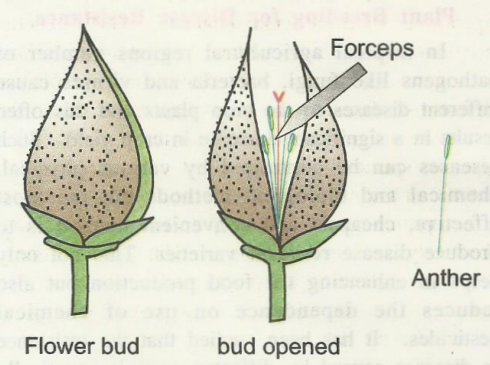
Emasculation (Forceps Method)
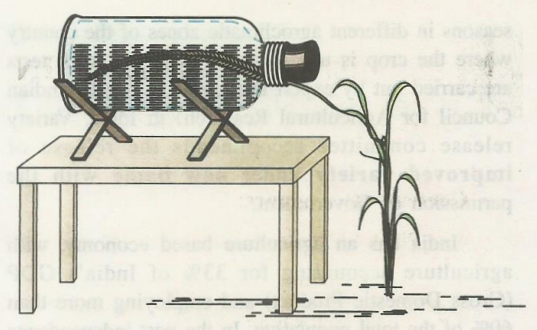
Emasculation (Hot Water Method)
It is not required when selected plant to be used as a female parent, bears unisexual flowers.
Emasculated flowers are covered with butter paper bags of suitable size to prevent pollination by pollen grains of unwanted source.
This process is called bagging.
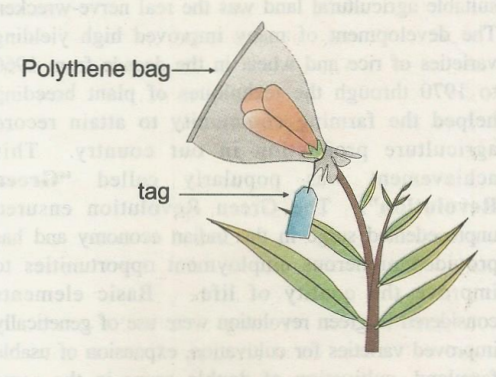
Bagging
When the stigma of bagged flowers become receptive, matured pollen grains are collected from anthers of selected male parent and are dusted on the stigma of female parent.
The female flowers are rebagged, and the fruits are allowed to develop.
