5.2 MICROBES IN INDUSTRIAL PRODUCTION:
a) Production of Alcoholic Beverages:
Alcoholic beverages are the products of alcoholic fermentation of specific substrates.
They include liquors like wine, beer and whisky.
The use of microbes in making fermented beverages is known since about 700 B.C. to Egyptians, Romans and Greeks.
A number of strains of the yeast, Saccharomyces cerevisiae var. ellipsoideus are used in industrial production of wine.
Different flavours of wine are obtained by using different fruit juices.
Beer is another alcoholic liquor obtained from fermented grains, mostly barley.
Suitable strains of S. cerevisiae are used for fermentation.
It is produced through various steps like
- malting,
- mashing and
- fermentation.
It is allowed to stand for a few days.
Then it is clarified, carboxylated, filled in bottles, packed and marketed.
Wine and beer are produced without distillation.
Whisky is obtained by fermenting mixed grains of corn, wheat, barley, etc.
The product of fermentation is then distilled.
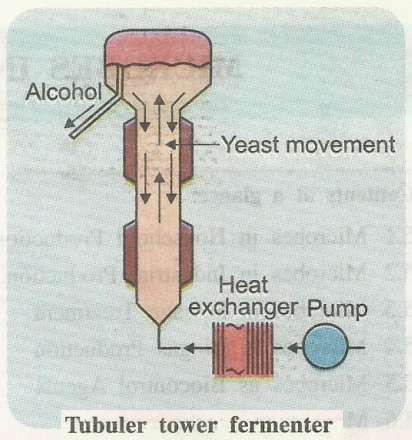
b) Organic Acid Fermentation:
A number of organic acids are obtained by fermentation using various microbes as given below.
|
Organic Acid |
Microbes Used |
|---|---|
|
Citric Acid |
Aspergillus niger |
|
Gluconic Acid |
Aspergillus niger |
|
Fumaric acid |
Rhizopus arrhizus |
|
Acetic acid (Vinegar) |
Acetobacter aceti |
c) Vitamin Production:
Vitamins are complex organic compounds required in very small quantities for normal growth and development of the body.
They include vitamins A, B, C, D, E and K.
They may be water soluble (vitamins B and C) or fat soluble (vitamins A, D,E and K).
All the vitamins are not produced in human body.
Therefore, they are to be consumed through food or tablets.
Vitamins are manufactured by fermentation technology using different microbial sources as given below.
|
Name of Vitamin |
Microbial Source |
|---|---|
|
Vitamin B2 |
i) Neurospora gossypii ii) Eremothecium ashbyi |
|
Vitamin B12 |
Pseudomonas denitrificans |
|
Vitamin C |
Aspergillus niger |
d) Antibiotic Production:
Some secondary metabolites , products of fermentation, have therapeutic importance and are used in medical treatment.
For example, penicillin and a number of other antibiotics are used in control of infectious diseases.
Antibiotics are the substances produced in small amounts by certain microbes to inhibit the growth of other microbes.
They may be anti-fungal (fungistatic or fungicidal ) or anti-bacterial (bacteristatic or bactericidal) in nature.
The first antibiotic was discovered accidentally by the British physician Dr. Alexander Fleming in 1929 when he was working with the pathogenic bacterium Staphylococcus aureus.
Since then a number of antibiotics have been produced and used therapeutically.
Some common antibiotics and their microbial sources are listed below.
|
Antibiotic Produced |
Microbial Source |
|---|---|
|
Cholormycetin |
Streptomyces venezuelae |
|
Erythromycin |
Streptomyces erythreus |
|
Penicillin |
Penicillium chrysogenum |
|
Streptomycin |
Streptomyces griseus |
Many deadly diseases such as plague, whooping cough, diphtheria and leprosy, which used to kill millions all over the world can be now controlled by antibiotics.
e) Gibberellin Production:
Gibberellins are a group of growth hormones mainly produced by higher plants and fungi to promote growth by stem elongation.
The first gibberellin was isolated by two Japanese scientists Yabuta and Sumiki in 1938 from rice seedlings infected with the fungus Gibberella fujikuroi.
About 15 types of gibberellins have been isolated from G. fujikuroi.
Gibberellins have many practical applications.
They are used
- induce parthenocarpy in apple, pear etc.
- breaking dormancy
- inducing flowering.
f) Enzyme Production:
Enzymes are biocatalysts, which either initiate or accelerate all biochemical processes in living organisms.
A number of hydrolytic enzymes that degrade starch, proteins, fats and pectin into simple compounds are known.
Traditionally, amylase, papain and pectinase were used in food processing.
In recent years, many more enzymes are being produced for
- getting desirable flavour of cheese and butter,
- sweetness of confectionaries,
- animal feed,
- soyabean milk,
- modification of food gums, etc.
Following are a few examples of enzymes used in industrial food processing.
|
Name of the enzyme |
Microbial source |
|---|---|
|
i) Invertase |
Saccharomyces cerevisiae |
|
ii) Pectinase |
Sclerotiana libertine |
|
iii) Lipase |
Rhizopus spp |
|
iv) Cellulase |
Trichoderma konigi |
g ) Dairy industry:
Various products are obtained from milk in dairy industry using microbial species.
Some of these products are cheese, yoghurt, buttermilk, paneer etc. Species of Streptomyces, Penicillium and Lactobacillus are commonly employed.
At the domestic level, preparation of fermented milk products started in the early period of human civilization.
Curd and buttermilk were produced using lactic acid bacteria.
Cheese too is a product of fermentation by fungi.
