5.4 MICROBES IN BIOGAS PRODUCTION:
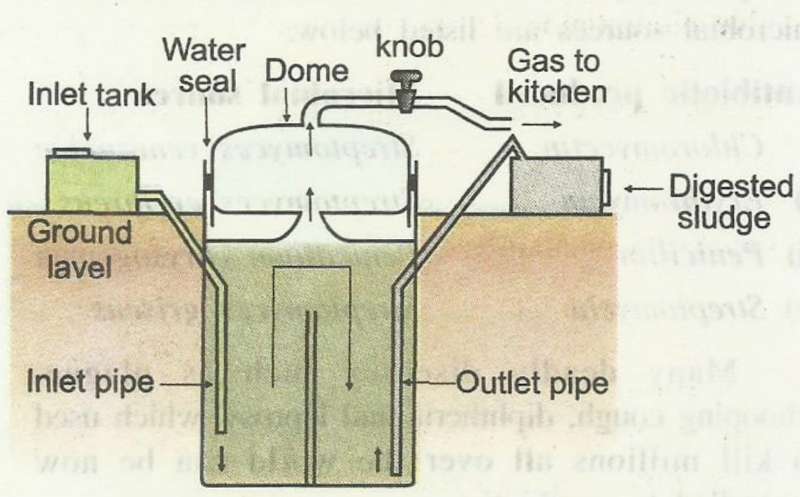
Biogas - which mainly contains methane - is used both as a domestic as well as industrial fuel.
It is a non-conventional and renewable source of energy and obtained by microbial fermentation.
Biogas production by microbes is a complex process.
It involves several anaerobic microbial species growing in
- marshy places,
- organic sediments and
- in the rumen (part of stomach) of ruminant animals.
Plant wastes and animal wastes are commonly used for biogas generation.
It includes domestic waste, agricultural waste, agro-industrial waste, municipal waste, forestry waste, etc.
The biogas contains about 50 - 80% methane, 15 - 45% CO, and other gases in traces.
Its chemical composition depends upon the nature of the waste material used and prevailing environmental conditions.
Biogas production involves 3 major processes-
- Anaerobic digestion or hydrolysis,
- Acetogenesis or Acidogenesis and
- Methanogenesis
Anaerobic digestion or hydrolysis
The anaerobic digestion occurs by certain anaerobic bacteria like species of Clostridium, Pseudomonas, etc.
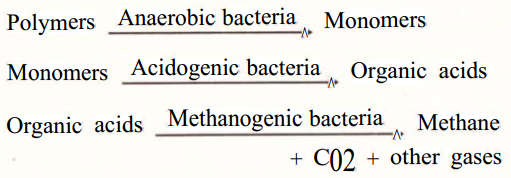
In this process, complex insoluble polymers are converted to simple soluble monomers with the help of bacterial hydrolytic enzymes.
Acetogenesis or Acidogenesis
These monomers are further converted into organic acids, chiefly acetic acid by enzymes of acidogenic bacteria.
Methanogenesis
Finally, acetic acid is transformed to biogas by the enzymes of methanogenic bacteria.
These bacteria include species of Methanococcus and Methanobacillus.
Biogas has several advantages.
1. It is a cheap, safe and renewable source of energy.
2. It can be used for domestic lighting, cooking, street lighting as well as small scale industries.
3. It bums with blue flame and without smoke.
4. It helps to improve sanitation of the surrounding.
5. It is eco-friendly and does not cause pollution and imbalance of the environment.
6. It can be easily generated, stored and transported.