5.6 MICROBES AS BIOFERTILIZERS:
For the ever increasing demand of agricultural products chemical fertilizers are traditionally used on large scale to obtain more yield.
The overuse of the chemical fertilizers, significant one is they cause pollution
Therefore, for better and sustainable agricultural production, the use of renewable nutritional sources, biofertilizers is necessary.
It is essential to switch over to organic farming.
The biofertilizers are mostly nitrogen-fixing microbes which enrich soil with nutrients.
They may be free living or symbiotic, bacteria or cyanobacteria.
Fungi as biofertilizers are mostly symbiotic and they accelerate water and nutrient uptake of crop plants and thereby increase the yield.
Bacterial Biofertilizers:
Rhizobia are the nitrogen fixing bacteria that form symbiotic association with roots of leguminous plants.
They bring about nodule formation on the roots and multiply inside the nodule.
They fix atmospheric nitrogen into organic forms which can be used by plants as nutrients.
There are many species of Rhizobium each specific for a particular species of leguminous plant.
E.g.
R. leguminosarum is specific to pea.
R. phaseoli to beans.
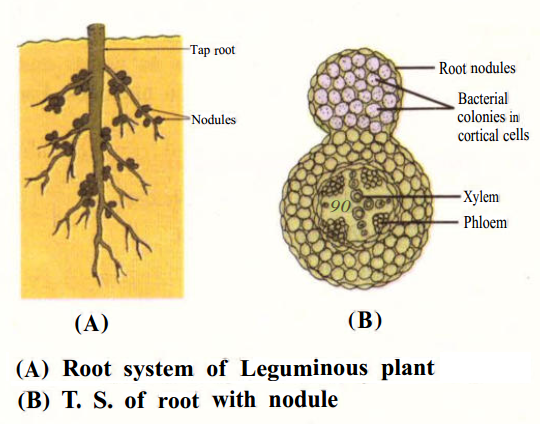
Pure culture of specific species is now raised in the laboratory, and is used to prepare a biofertilizer.
Free living nitrogen fixing bacteria such as Azotobacter and Azospirillum are also used as biofertilizers.
Cyanobacterial Biofertilizers
Cyanobacteria are autotrophic microbes that are widely distributed in aquatic and terrestrial environment.
Many are free living, filamentous and are used as biofertilizers in paddy fields (Rice)
e.g. Aulosira, Tolypotlirix, Nostoc, etc. These blue green algae (BGA) have some specialized and colourless cells, called heterocysts which are the sites for nitrogen fixation.
Some species of Anabaena are symbiotic.( Anabaena azollae ).
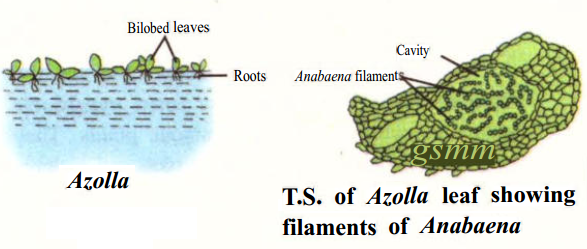
Azolla is an aquatic fern. It propagates vegetatively and spreads in rice-fields very rapidly.
Anabaena filaments are with heterocyst and they multiply inside the air space of the dorsal lobe of leaves of Azolla.
Anabaena azollae and Nostoc are commonly used as biofertilizer for rice.
Ectomycorrhizae and Endomycorhizae
Ectomycorrhizae have well developed mycelium which forms mantle on the outside of the roots.
This increases surface area of roots and accelerates water and nutrient uptake.
Due to this the plant vigour, growth and yield increase.
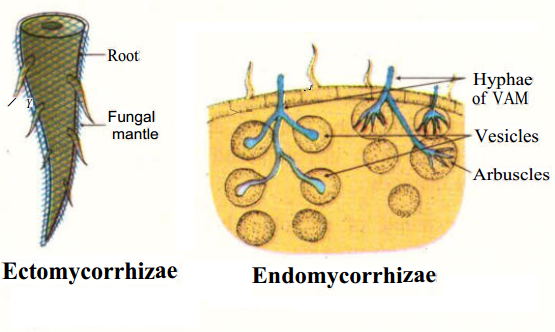
Endomycorrhizae grow in between and within the cortical cells of roots.
Fungal hyphae penetrate the cells and form vesicles or finely branched arbuscles. Hence they are called Vesicular Arbuscular Mycorrhizae or VAM.
The plants with VAM grow luxuriently in less irrigated lands.
Thus association of VAM with crop plants help in conversion of less productive field into more productive field.
