9.7 Environmental issues -
Agrochemicals and their effects:
Agrochemical pesticides are very important in crop protection.
Intensive use of pesticides over the years has posed severe environmental problems. They include
- contamination of soil and groundwater,
- reduced productivity,
- development of pesticide resistance among the pests, etc.
When pesticides are applied to protect crop plants from pests and diseases, only about 15% of the spray preparation hits the target. The rest is distributed in the surrounding environment.
According to a report presented by the Food and Agriculture Organization (FAO) of the United Nations in the year 2000, soil is the chief medium for infiltration of pesticides to groundwater. Most of the soil pesticide residues are confined to the upper 5 cm of the top soil.
The agrochemicals can move to deeper layers of soil through percolation of water and finally reach the groundwater reserve.
Various factors are known to influence leaching of agrochemicals into groundwater. They include
- the amount of rainfall,
- soil drainage,
- depth of water table,
- mobility of pesticides,
- soil texture, etc.
- It also includes agronomic factors , like timing, rate and method of pesticide application, etc.
Endosulfan is relatively less mobile, but found to be mosl common pesticide of groundwater samples. Pesticides in shallow groundwater are of particular concern.
Several agrochemicals are also found contaminating food. They cause hazardous effects on humans, animals and crop plants.
Over use of chemical fertilizers to increase yield also should be avoided.
- Most of the agrochemicals are general poisons and not specific for a particular species of pest.
- They kill useful pollinators and microorganisms of the soil which includes the nitrogen fixing bacteria and cyanobacteria which can be used as biofertilizers.
Thus natural productivity of the soil is greatly affected.
In general, the pests manage to survive and become more resistant to pesticides.
Obviously to control such resistant pests greater amounts of pesticides are required which, in turn, increase their hazards.
Many pesticides especially organo-chlorines are non-biodegradable.
They persist in the environment. They pollute air, water, soil and enter food chains.
Being lipophilic, they get deposited in fatty tissues of organisms creating serious problems. The deposition of pesticides in fatty tissues of the host is called Bioaccumulation.
They may pass to higher members of ecosystem through food chain. Pesticides occur in increasing concentration in top members of food chain. This is called Biomagnification or Bioconcentration.
Many pesticides are toxic in nature. The person who handles them in industries or in fields may suffer from skin diseases, blindness, respiratory diseases, nervous disorders, etc.
Solid Waste management:
Solid waste is everything that is commonly called trash.
It includes wastes from homes, offices, stores, hospitals, hotels, schools and colleges.
Rapid increase in population and changed life- style has increased the amount of solid wastes tremendously.
Unplanned urbanization, industrializaion and increased human activities have resulted in deposition of huge quantities of garbage every day.
The Department of Waste Management of local Municipal bodies is facing endless problems in waste disposal.
The people engaged in waste disposal are almost incapable of finishing their jobs.
The municipal solid wastes generally include; domestic (food) waste, paper, plastic, glass, metals, rubber, leather, textile, etc.
Open burning dumps were used, as burning reduces the volume of wastes.
But this is hazardous as generally it is not burnt to completion and open dumps serve as the breeding place for rats and flies.
To substitute these, sanitary landfills were adopted, where wastes are dumped in a trench or depression after compaction and covered with soil everyday.
Landfills also are inadequate as the amount of garbage, especially in metros has increased so much, that these sites are getting filled too.
Moreover, there is a danger of seepage of chemicals, etc. from these landfills which may pollute underground water resources.
Citizen's role -
In the light of above situation, each citizen is required to be more sensitive to this issue.
All the wastes can be categorized into three types;
1) bio-degradable,
2) non- biodegradable and
3) recyclable.
Everyone should sort out the wastes. The biodegradable materials can be put into deep pits and be left for natural break down.
Every independent house or condominium of apartments should have a pit for domestic wastes.
Recyclable, like news paper and plastic bags of milk etc. should be given to kabadiwallahs.
This leaves only non-biodegradable to be disposed off.
Every citizen should try to reduce garbage generation and minimize the use of non-biodegradable products.
One should refuse polythene carry-bags and start carrying cloth carry-bags.
Case study: Polyblend, a Remedy for Plastic Waste:
Ahmed Khan of Bangalore has been producing plastic sacks for 20 years.
When he realized that the plastic waste is a real problem, his company developed, Polyblend, a fine powder of recycled modified plastic.
In collaboration with Bangalore City Corporation and R.V. College of engineering A. Khan proved that, if Polyblend is mixed with bitumen and is used to lay roads, road life is increased.
This is because; Polyblend enhances bitumen's water repellant properties. Using Khan's technique over 40kms of road in Bangalore has been laid.
Formerly, rag pickers use to get Rs. 0.40 for 1kg. plastic waste. Khan offers them Rs. 6. This was in 2002, at this rate; soon Bangalore City will have better roads and will run short of plastic.
Greenhouse effect and Global Warming:
The solar energy is carried to the earth in three forms -
- ultra-violet radiations,
- visible light and
- infrared and radio waves.,
Harmful UV radiations are absorbed by the ozone layer of the stratosphere before the sunrays reach the earth surface.
The infrared rays pass through the carbon dioxide layer in the lower region of the atmosphere.
Since the infrared radiation has heating effect, it warms-up the earth, its atmosphere and various objects.
A part of infrared radiations falling on the earth surface and which have longer wavelengths is reflected back into the outer space.
They cannot escape out from the CO2 layer present in the atmosphere.
Carbon dioxide, along with methane, nitrogen oxides and CFCs (chlorofluorocarbon) can absorb infrared radiations reflected from earth surface. Therefore, the blanket of these gases in the atmosphere traps reflected infrared rays and produces heat on the earth surface.
The heating-up of earth's atmosphere due to trapped inrared rays reflected rom earth surface by atmospheric gases is called greenhouse effect. It is the main cause of global warming.
Do you know why the term green house effect is used for this heating-up of earth? And what is a green house?
Green house is actually a small glass house used for growing plants especially during winter.
In this green (glass) house, the glass panel lets the light in for photosynthesis to take place but does not allow heat to escape.
As a result, the green house warms up. Hence the term green house effect is used.
The green house effect is naturally occurring phenomenon and without green house effect the average temperature at surface of earth would have been chilly, -18 C rather than the present average of 15 C.
Global warming caused by greenhouse effect depends upon the amount of CO2 present in the atmosphere.
An increase in the CO2 concentration in the atmosphere retains heat energy of the sunrays and increases earth's temperature
Greenhouse Gases
The gases of the atmosphere that cause rise in earth's temperature are called greenhouse gases. They ae mainly
- CO2 (59%),
- CFCs (19%),
- Methane (15%),
- Nitrogen gases (6%) and
- Others (1%).
Greenhouse gases are discharged in the earth's atmosphere through various sources. They include
1. burning of fossil fuels,
2. destruction of forests,
3. cement plants etc.
4. CFCs are released chiefly through industrial activities, refrigerators and air-conditioners.
It has been observed that
- CO2 alone increase temperature by about 50%,
- CFCs increases temperature by 20%,
- Methane increases temperature by 15% and
- Other air pollutants increases temperature by 10%.
Thus global warming is a result of atmospheric pollution.
A slight increase in the temperature of the earth has been found during the last 50 years. It is evidenced from the following illustration
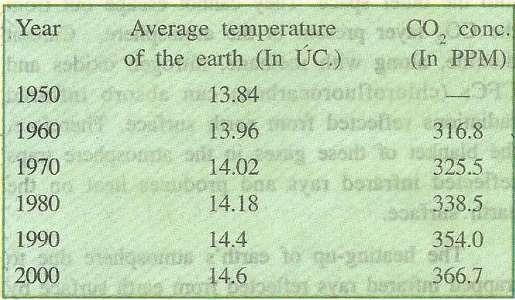
Industrialization, deforestation and greenhouse effect are the major factors responsible for global warming.
Global warming causes several hazardous effects on earth and living organisms.
They include
1. melting of glaciers, polar ice-caps,
2. increase in sea level, flooding of low-lying coastal areas,
3. change in rainfall pattern,
4. destruction of agricultural crops due to occurrence of cyclones and hurricanes, etc.
Ozone Depletion in the Stratosphere:
Bad Ozone:
Ozone formed in the lower atmosphere called troposphere harms plants and animals, so this is 'bad' ozone.
Good Ozone:
There is 'good' ozone also present in the upper part of the atmosphere called stratosphere.
This ozone absorbs ultraviolet radiation from the Sun which is harmful to living organisms.
DNA and protein of living organisms absorb UV rays and its high energy breaks down the chemical bonds within these molecules.
This causes damage to skin cells and skin cancer of different types.
High dose of UV-B causes inflammation of cornea, called snow-blindness cataract.
Thus UV radiations are injurious.
Ozone gas is continuously formed by the action of UV rays on molecular oxygen.
Simultaneously it is degraded also into molecular oxygen.
There should be a balance between production and degradation of ozone in the stratosphere.
Due to CFCs (chlorofluorocarbons) this balance is disturbed and degradation of ozone is more, causing the ozone layer depletion.
CFCs are widely used in refrigerants. CFCs discharged in the lower part of the atmosphere move and reach stratosphere.
When UV rays act on CFCs, Cl atoms are released and they degrade ozone. Cl atoms are not consumed, they just act as catalysts. Therefore, they continue to degrade ozone.
Ozone depletion is occurring widely in the stratosphere.
In the Antarctic region there is formation of a large area of thin ozone layer, which is commonly called ozone hole. An international treaty, known as Montreal Protocol, was signed at Montreal (Canada) in 1987 (effective in 1989) to control the emission of ozone depleting substances, mainly CFCs.
Deforestation:
The permanent removal, decrease or deterioration of forests and woodlands is called deforestation.
Human activities through a long time are chiefly responsible for deforestation. Deforestation has resulted in considerable decrease in forest land.
The recommended forest area is about 33% of the total land area. The forest cover of India is presently about 19% only.
The causes of deforestation include intensive collecion of firewood, clearing of land for agriculture, developing pastures for grazing animals, to carry out mining activities, to earn foreign exchange by selling wood, to obtain land for construction of roads, buildings and dams, to meet increasing demand of timber wood, to acquire land for industies, natural calamities like wildfire, floods, eathquakes, volcanic eruptions, storms, etc.
Slash and burn agiculture, (commonly known as Jhum cultivation) was the main cause of deforestation in the north- eastern states of India.
Deforestation poses several environmental problems.
Some impotant effects of deforestation are
1. extinction of species,
2. reduced soil fetility,
3. soil erosion,
4. change in climate,
5. shrinking fuel wood,
6. shotage of timber,
7. incidents of landslides,
8. global warming.
Conservation and management of forests
It can minimize effects of deforestation. It may be done by
1. effective control of wild fire using suitable measures,
2. regulating grazing of animals in forest lands,
3. protection of forests from pests and pathogens,
4. economic use of timber and fuel wood to avoid its wastage,
5. forest conservation through law,
6. adopting reforestation and afforestation programmes,
7. encouraging agro-forestry,
8. educating people about hazards of deforestation,
Reforestation is restoring a forest that once existed and plantation of trees in barren and unexploited land to improve environment is known as afforestation.
Agro-forestry is using the same land for agriculture and forestry.
Motivating people include awarding persons for their outstanding work in tree plantation would also help in this connection.
Every year 5th June is observed as the World Environment Day.
Case Study: Amrita Devi Bishnoi
Amrita Devi and other Bishnoi's sacrifice of their lives for conservation of forest in 1731.
The king of Jodhpur in Rajasthan, ordered to arrange wood for the construction of a new palace. King's men went to a forest near a village, inhabited by Bishnois.
Bishnois were very much dependent on the various forest products for their living.
Amrita Devi, a Bishnoi woman showed courage by hugging a tree and telling king's men to cut her first before cutting the tree.
Unfortunately, king's men, may be were more afraid of king, cut down the tree along with Amrita Devi.
Her three daughters and hundreds of other Bishnois followed her and lost their lives to save trees.
The Government of India has recently declared the Amrita Devi Bishnoi Wildlife Protection Award for individuals or communities that show courage and dedication in protecting wildlife.
Case Study: Chipko Movement of Garhwal Himalayas
People all over the world have acclaimed the Chipko Movement of Garhwal Himalayas.
In 1974, local women of Garhwal, showed courage of hugging trees to successfully prevent the cutting of trees by contractors.
This shows that participation of local communities in conservation of forests is important.
The Government of India has introduced the concept of Joint Forest Management (JFM) to work closely and effectively with local communities for protecting forests.
The communities get benefit of various forest products, such as, fruits, gum, rubber, tannin, resin, medicines, etc. and forest is conserved in a sustainable manner.
