19.5 ENVIRONMENTAL ISSUES:
Air Pollution and its control:
Air pollution is considered to be one of the most dangerous and common kind of environmental pollution. According to WHO, air pollution may be defined as follows:
"Substances present in the air produced by the activity of mankind in concentration sufficient to cause harmful effect to his health, vegetables, property or to interfere with the enjoyment of his property."
Bhopal Gas Tragedy
Methyl-iso-cyanate (MIC) gas leak in Bhopal in 1984 is to led drastic air pollution. It has been regarded as the worst industrial accident.
In this Bhopal Gas Tragedy at least 5000 people were killed by the leakage of poisonous MIC gas from the Union Carbide Pesticide Plant.
MIC reacts quickly with water and causes the lungs to swell and eyes to develop cataract.
Many people in Bhopal died because their lungs had filled with fluid.
It is estimated that some 50,000 people have been seriously affected and became blind. Bhopal's victims continue to die till today. Out of three children born to women who were pregnant on the night of the disaster, only one survived. Out of 1,350 new bom babies, 16 were physically deformed and 60 premature births. Deformed children suffered from congenital hearts, holes in arms and impaired eye sight. The vegetation in areas of 3.5 sq. km. around the Union Carbide factory at Bhopal was severely affected. In affected localities, the consumption of fruits like mango, papaya and tamarind was avoided for that season.
The major sources of air pollution are the particulate matter and the gaseous matter which get released by the burning of fossil fuels such as coal, petroleum etc.
The particulate matter includes the solid and liquid aerosols suspended in the atmosphere. They come either from condensation processes or from dispersion processes ( erosion, grinding , spraying etc.).
Although "smoke" is properly used to denote mixtures of particulate matter, fumes, gases, and mists, it refers to solid condensation aerosols.
"Dust" refers to solid dispersion aerosols and "mist" to liquid aerosols.
A variety of emissions coming out of the particulate matter and gaseous matter are :
(1) Fine particles (less than lOμm in diameter), which include carbon particles, metallic dusts, tars, resins, aerosols, solid oxides, nitrates, and sulphates;
(2) Coarser particles (over20 μm), largely carbon particles and heavy dust that is quickly removed by gravity from the air;
(3) Sulphur compounds;
(4) Nitrogen compounds;
(5) Oxygen compounds;
(6) Halogens; and
(7) Radioactive substances.
All these pollutants have been artificial pollutants and they are poured in air mainly by at least five major fuel burning sources;
1. Automobiles (cars, scooters, motorcycles) have been regarded the greatest sources of the air pollution. They produce nearly two-thirds of the carbon monoxide and one-half of the hydrocarbons and nitrous oxides. The automobile exhaust has also gaseous lead and particulate lead.
2. Electric power plants burning fossil fuels, particularly coal and sometimes petrol or diesel, produce two-thirds of the sulphur dioxides.
3. Industrial processes like metallurgical plants and smelters, chemical plants, petroleum refineries, pulp and paper mills, sugar mills, cotton mills, and synthetic rubber manufacturing plants have been responsible for about one-fifth of the air pollution.
4. Heating plants for homes, apartments, schools, and industrial buildings are the fourth largest source of air pollution.
5. The transportation industry exclusive of automobiles and including railroads, ships, aircrafts, trucks, buses, tractors etc. have been contributing the same type of pollutants as cars.
Other sources of air pollution are minor in quantities, but bear significance. They are
- dust from agriculture practices,
- pesticides,
- field burning
- the construction industry
- The natural pollutants are pollen, hydrocarbons released by vegetation,
- dusts from deserts, storms, and volcanic activity.
Man-made air pollution in urban areas is often referred to as "smog". The word "smog" was apparently coined in 1905 by Dr. H. A. Des Voeux, an active organizer of British smoke abatement societies, to describe the "smoke-fog" of the London pea-soupers.
In order to measure and control the magnitude of air pollution in various industrial centres of India, National Environmental Engineering Research Institute (NEERI) has established air monitoring stations in Mumbai, Kolkata, Delhi, Chennai, Hyderabad, Kanpur, Jaipur, Ahmedabad and Nagpur.
In one of the survey conducted by NEERI in 1980 to measure the air pollution by sulphur dioxide (S02) and suspended particles in some major cities of India found that Chembur-Trombay area of Mumbai is having the highest S02 pollution, while New Delhi is having the highest air pollution of suspended particulate matter. In another survey, Kolkata is reported to have the highest carbon monoxide (CO) pollution during peak traffic hours.
Hazards of air pollution.
1. Sulphur dioxides SO2
Sulphur dioxides can damage materials and property, mainly through their conversion into the highly reactive sulphuric acid. Discolouration and physical deterioration are produced in building materials and sculpture. S02 also affects vegetation adversely even at concentrations below 0.03 ppm. S02 and H2S04 are both capable of irritating the respiratory system of animals and human beings.
2. Hydrogen sulphide (H2S)
Exposure to hydrogen sulphide (H2S) results in leaf lesions, defoliation and reduced growth. H2S causes headache, nausea, collapse, conjunctivitis, irritation of mucous membranes, colic diarrhea, bronchial pneumonia, coma and even death. Some people lose their appetite due to an unpleasant odour of H2S at 5ppm.
3. Carbon monooxide [CO]
The toxic effects of CO on human beings and animals arise from its reversible combination with haemoglobin (Hb) in the blood:
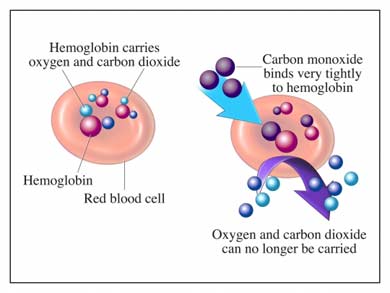
Haemoglobin is having a much greater affinity for CO than it has for 02. The combination of haemoglobin with CO reduces the oxygen carrying capacity of the blood so that less 02 is available to the body cells. Smokers who smoke a pack of cigarettes daily may have blood HbCO levels of 5% or more.
They suffer from
- impairment of mental performance
- visual acuity.
CO is supposed to inhibit cellular respiration in plants by reacting with cytochrome oxidase enzyme system.
3. Nitrous Oxide, N2O
The air pollutant nitrous oxide, N2O ( laughing gas ) can prove lethal to human beings and animals at the exposure to 100 ppm or more for a few minutes. Its long exposure can cause an acute respiratory disease in humans.
4. Tobacco smoke
It causes lung cancer, pulmonary and coronary heart diseases; thickening of bronchial epithelial layer, loss of ciliated cells, appearance of cells with bizarre nuclei, which are probably the precursors of cancerous cells.
In general, air pollution affects human health and causes many diseases namely,
- black lung disease,
- asbestosis,
- emphysema,
- chronic bronchitis,
- pollen allergies,
- lung cancer
PREVENTION AND CONTROL OF AIR POLLUTION:
Air pollution can be controlled by the following practical measures. First of all, desirable and harmless air quality standards have to be established.
Once done, adequate legislation has to compel control of pollutants at their sources. Source control and abatement of formed contaminants have been complementary practices in the campaign against air pollution.
Source control disallows the emission of contaminants to the atmosphere. Abatement renders the emission of contaminants to the atmosphere harmless and inoffensive. For this, the devices like positive crankcase ventilation valve and catalytic converter should be fully maintained by the public to reduce exhaust emissions.
1. Pollution under control (PUC) certificate is mandatory for all vehicles to check pollution.
2. The particulate pollution from industry and power generation can be controlled by electrostatic precipitators which are capable of reducing smoke and dust. Gaseous pollutants of industry and power station can be removed by chemical means, i.e. differential solubility of gases in water.
- A fine spray of water in a device known as "scrubber" can effectively separate many gases such as ammonia and sulphur dioxide.
- The other gases can be removed by filtration or absorption through activated carbon.
- Technology for control of emission should be adopted for all types of vehicle using petrol or diesel and severe punishment should be specified to the defaulters. Bombay Motor Vehicles (Amendment) Act, 1984 empowers authority to suspend, (after a grace period of 14 days), the registration of vehicles which are emitting pollutants beyond a certain specified limit.
- Two stroke engines cause more pollution, hence they should be replaced by using the advanced of technology for four stroke engines. Instead of burning petrol which causes air pollution unleaded petrol is recommended to reduce pollution. In addition to this instead of Petrol, CNG (Compressed natural gas) is used.
- A diesel engine can be modified so that it will be able to run on a mixed fuel containing up to 40 % methanol. Methanol is a completely clean burning fuel that forms only steam and water. Its flame speed has been higher than that of even gasoline.
- In India, according to the air pollution control act, air pollution boards are established at the Central and State levels. These boards have the powers to issue and revoke licences to polluting industries, enforce emission standards and frame rules and regulations for the control of air pollution. The act is primarily directed to the highly polluting industries such as iron and steel, textiles and power plants. The legislation also bans the burning of garbage and other waste products in urban areas as well as the fouling of the air by burning smoking fuels for domestic purposes.
