9.2 Ecosystem - Pattern, Components, Productivity and Decomposition
(Eco - environment, system - an interacting, inter-dependent complex.)
An ecosystem is the whole biotic community in a given area plus its abiotic environment.
It is a system which is formed due to the interaction among all the living organisms living in a particular given area aid also their interaction with their physical environment.
There are two main kinds of ecosystems as (a) Natural and (b) Artificial.
Natural ecosystems:
These ecosystems operate under natural conditions without any major interference of man.
They may be;
(i) Terrestrial, as forest, grassland, desert etc.
(ii) Aquatic, as pond, river, lake, wetland, estuary etc.
Artificial ecosystems:
These are man-engineered and maintained artificially by man by addition of energy and planned manipulations.
e.g. croplands and an aquarium.
Structure and Function of Ecosystem
For study of any ecosystem we have to consider its structure and function.
The structure includes
i. The composition of biological community i.e. the species, numbers, biomass and distribution.
ii. The quantity and distribution of non-living materials as nutrients, water etc.
iii. The range or gradient of conditions of existence, such as temperature, light etc.
The term 'function' means 'the biological energy flow'.
It is the production and respiration rates of the community, nutrient cycles and regulation of the organisms by the environment and regulation of environment by the organisms.
Components of Ecosystem:
An ecosystem has two main components as abiotic and biotic.
Abiotic components:
These include the climate, organic compounds as proteins, carbohydrates, lipids etc. and inorganic substances like Ca, Mg, Fe, P, S, C, N, etc.
Biotic components:
These include the living organisms of an ecosystem. They may be autotrophic (producers / converters) , as green plants or photosynthetic / chemosynthetic microorganisms or heterotrophic.
The heterotrophic organisms are of two types namely macro-consumers and micro consumers. The macro-consumers are herbivores and carnivores (or omnivores).
The herbivores are primary consumers while the carnivores or omnivores may be secondary or tertiary consumers.
The micro-consumers are commonly called decomposers. They are saprophytes and include bacteria, actinomycetes and fungi.
They play an important role in releasing the inorganic nutrients back in the environment by decomposing the complex compounds from dead or living protoplasm.
Ecosystem Structures and Patterns:
In an ecosystem, abiotic and biotic factors vary as locations vary in space and time.
Air temperature may be a limiting factor in certain parts of an ecosystem and factors such as precipitation (rain fall) may limit wildlife in other parts.
Due to such variations, spatial (related with space) patterns arise in an ecosystem.
There are 2 recognized spatial patterns:
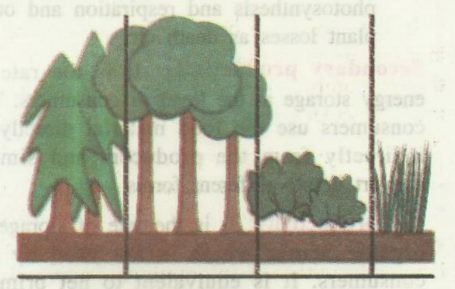
Zonation:
This spatial pattern occurs horizontally along the ground.
Density and distribution of species vary along a horizontal gradient
Stratification:
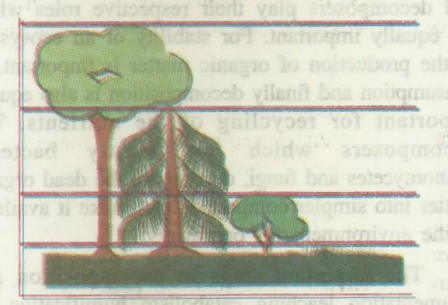
This spatial pattern occurs vertically, determined by height of organisms.
For example, in a forest community, stratification takes place when trees of different species grow to different heights.
Productivity of ecosystem:
It refers to the rate of production i.e. the amount of organic matter (biomass) accumulated in any unit time.
Primary productivity:
It is associated with the autotrophic, (photosynthetic and chemosynthetic) organisms which may be green plants or microorganisms.
It can be considered as 'the rate at which the radiant (solar) energy is converted and stored by the producers.
It can be again classified in to two categories as
a) Gross primary productivity:
It is the total rate of photosynthesis including the organic matter used up during respiration.
It is estimated in terms of either chlorophyll content as chl/g dry wt. / unit area or photosynthetic number as C02 fixed/g chl/hour.
b) Net primary productivity:
It is the actual amount of organic matter stored by green plants apart from its use in respiration.
It is thus the rate of increase in biomass. It refers to the balance of gross photosynthesis and respiration and other plant losses as death etc.
Secondary productivity:
It is the rate of energy storage at the level of consumers.
The consumers use the food material directly or indirectly from the producers and simply convert it into different forms.
Net productivity:
It is the rate of storage of organic matter which is not used by the consumers.
It is equivalent to net primary production minus consumption by the heterotrophic organisms.
It is generally expressed as 'production of C g/m2/day.
Decomposition:
In any ecosystem the producers, consumers and decomposers play their respective roles which are equally important.
For stability of an ecosystem as the production of organic matter is important, its consumption and finally decomposition is also equally important for recycling of the nutrients.
The decomposers which are mostly bacteria, actinomycetes and fungi, decompose the dead organic matter into simpler compounds and make it available in the environment for organisms.
The important steps in decomposition are:
- fragmentation,
- leaching,
- catabohsm,
- humification and
- mineralization.
It takes place through the detritus food chain, which starts from the dead organic matter.
Detritivores like earthworm, breakdown detritus into smaller particles.
This process is called fragmentation.
Water soluble inorganic nutrients go down into the soil horizon get precipitated as salts, this process is called leaching.
Fungal and bacterial enzymes degrade detritus into simple inorganic substances, this is called catabolism.
Fragmentation, leaching and catabolism operate simultaneously on the detritus.
Partially decomposed organic matter is called humus.
Humification is formation of humus which is a dark coloured amorphous substance. It is a reservoir of nutrients.
Humus undergoes decomposition at very slow rate as it is resistant to microbial action.
The degradation of humus by some microbes release inorganic nutrients and this process is called mineralization.
Decomposition is largely an oxygen requiring process.
Rate of decomposition is faster in warm and moist environment.
Low temperature and anaerobic condition inhibit decomposition.
