9.3 Pyramids of number, biomass and energy.
Pyramid of numbers -
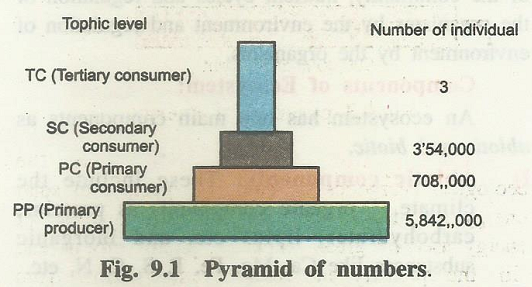
It shows the relationships between producers, herbivores and carnivores at successive trophic levels in terms of their numbers.
For example, in grassland, the producers which are mainly grasses are always more in number.
This number goes on reducing from base to the apex of the pyramid.
The primary consumers as rabbits, mice etc. are lesser than the number of grasses.
As we go in upward direction i.e. to secondary, tertiary / top level consumers as hawk or other birds, their number will be least.
Thus the pyramid is upright.
Pyramid of biomass-
In most of the ecosystems pyramid of biomass is upright like pyramid of numbers.
Producers are always more in biomass than herbivores and herbivores are more in biomass than the carnivores.
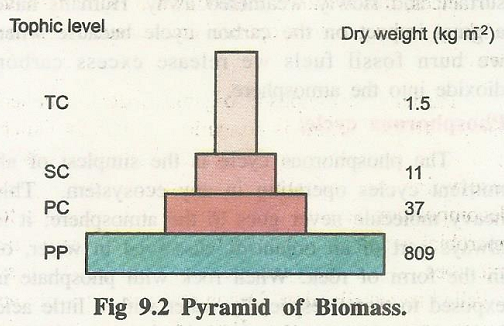
There are exceptions to this generalization.
The number of small insects feeding on a single big tree is more.
The pyramid of biomass in sea is also inverted because the biomass of fishes is more than that of phytoplankton.
Pyramid of Energy-
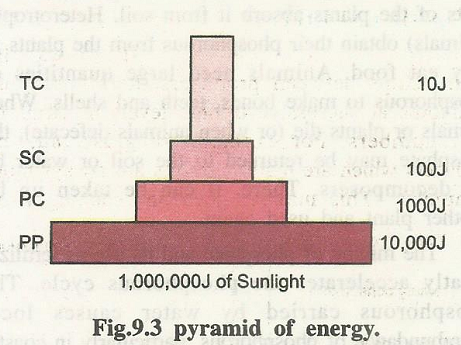
Pyramid of energy is always upright, it can never be inverted.
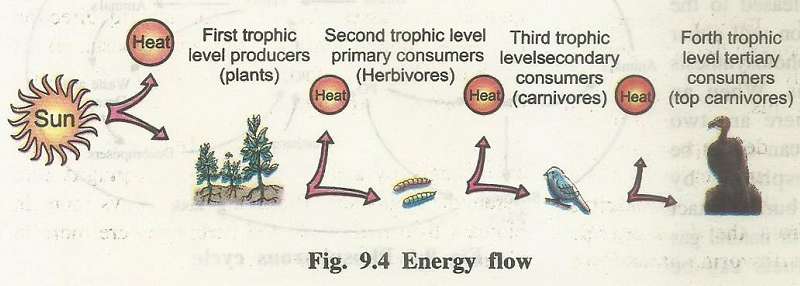
When energy flows from a particular trophic level to the next, some energy is lost as heat at every step.
Energy flow in ecosystem -
In the ecological energetics we study
(i) quantity of solar energy reaching to the ecosystem,
(ii) quantity of energy used by green plants for photosynthesis and
(iii) the quantity and path of energy flow from producers to consumers.
About 34% of the sunlight is relected back, 10% is held by ozone layer, water vapour and other atmospheric gases and 56% reaches to earth's surface.
Of the total sunlight reaching to the earth's atmosphere only a fraction i.e. 0.02% is used for photosynthesis.
In the ecosystem the energy flow is unidirectional.
To understand the process better, we have to consider;
i) the eficiency of the producers in absorption and conversion of solar energy,
ii) Use of this converted energy by the consumers,
iii) The total input of energy in form of food and its efficiency of assimilation,
iv) The loss through respiration, heat, excretion etc and
v) The gross and net production.
There is unidirectional flow of energy. The energy captured by autotrophs does not go back to the solar input or the energy which passes to herbivores does not go back to autotrophs. As the energy lows progressively through various trophic levels it is no longer available to the previous trophic level. As the energy passes form one to the next trophic level it goes on decreasing.
This is due to the energy dissipated as heat during various metabolic activities of the organisms.
It is measured as respiration coupled with unutilized energy.
In any ecosystem the energy flows from producers who capture and convert it from the radiant solar energy to primary - secondary -tertiary consumers.
Thus shorter the food chain, greater would be the available food energy and as the length of food chain increases, there is corresponding more loss of energy.
