9.4 Nutrient cycles in ecosystems - carbon and phosphorous
Carbon Cycle:
Carbon constitutes 49% of dry weight of organisms.
Out of total quantity of global carbon, 71% is found dissolved in oceans. Thus ocean is a reservoir of carbon.
Fossil fuels also represent a reservoir of carbon. Carbon cycle is very simple. The key events here are the complementary reactions of respiration and photosynthesis.
Respiration takes carbohydrates and oxygen and releases carbon dioxide, water, and energy.
Photosynthesis takes carbon dioxide and water and produces carbohydrates and oxygen.
Photosynthesis takes energy from the sun and stores it in the carbon-carbon bonds of carbohydrates; while respiration releases that energy.
The main reservoirs for carbon dioxide are in the oceans and in rock. Carbon dioxide dissolves readily in water. Once there, it may precipitate (fall out of solution) as a solid rock known as calcium carbonate (limestone). Corals and algae encourage this reaction and build up limestone reefs in the process.
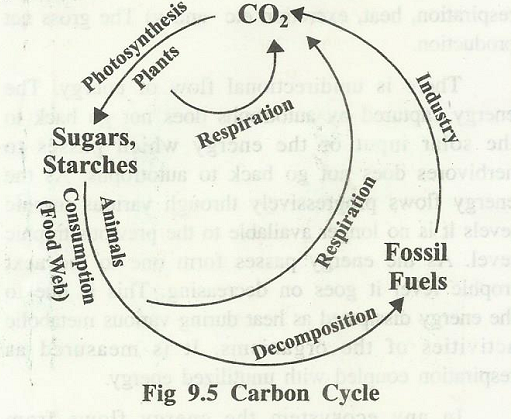
On land and in the water, plants take up carbon dioxide and convert it into carbohydrates through photosynthesis.
This carbon in the plants now has three possible fates.
1. It can be liberated to the atmosphere by the plant through respiration,
2. it can be consumed by an animal, or
3. it can remain as it when the plant dies.
Animals obtain all their carbon through their food, thus, all carbon in biological systems comes from plants (autotrophs).
In the animal, (consumers) the carbon also has the same three possible fates.
Carbon from plants or animals that is released to the atmosphere through respiration will either be taken up by a plant in photosynthesis or dissolved in the oceans.
When an animal or a plant dies, there are two possible fates of carbon, it can either be released to the atmosphere by decomposers, or it can be buried intact and ultimately form coal, oil, or natural gas (fossil fuels).
The fossil fuels can be mined and burned in the future; releasing carbon dioxide to the atmosphere or the carbon in limestone and other sediments can only be released to the atmosphere.
When they are subducted and brought to volcanoes, or when they are pushed to the surface and slowly weathered away.
Humans have a great impact on the carbon cycle because when we burn fossil fuels we release excess carbon dioxide into the atmosphere.
Phosphorous cycle:
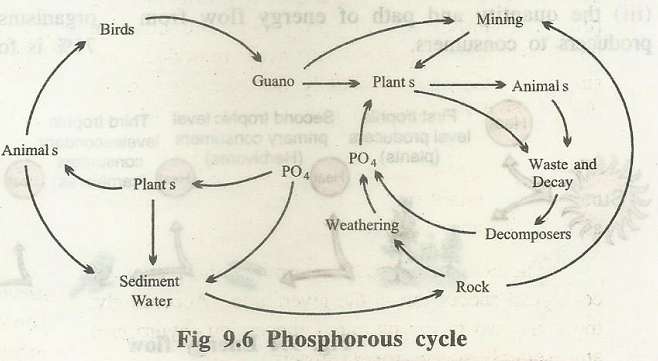
The phosphorous cycle is the simplest of all nutrient cycles operating in any ecosystem.
This heavy molecule never goes to the atmosphere; it is always part of an organism, dissolved in water, or in the form of rock.
When rock with phosphate is exposed to water (especially water with a little acid in it), the rock gets weathered and goes into solution.
Phosphorous is major constituent of DNA, RNA, and, of course ATP (adenosine triphosphate).
All organisms need phosphorous. Autotrophs, (plants) take up phosphorous in the form of phosphate, as roots of the plants absorb it from soil.
Heterotrophs (animals) obtain their phosphorous rom the plants as they eat food. Animals need large quantities of phosphorous to make bones, teeth and shells.
When animals or plants die (or when animals defecate), the phosphate may be returned to the soil or water by the decomposers.
There, it can be taken up by another plant and used again.
The mining of phosphate and its use as fertilizer greatly accelerates the phosphorous cycle.
The phosphorous carried by water causes local overabundance of phosphorous, particularly in coastal regions, at the mouths of rivers, and any place where there is a lot of sewage released into the water.
Local abundance of phosphate can cause overgrowth of algae in the water; the algae can use up all the oxygen in the water and kill other aquatic life.
This is called eutrophication.
Marine birds play a unique role in the phosphorous cycle. These birds eat marine fish, which is rich in phosphorous.
Their excreta called 'guano deposits' contain high levels of phosphorous and thus marine birds return phosphorous from the ocean to the land.