B. Mitosis :
This is a type of cell division in which a cell divides to form two similar daughter cells which are identical to the parent cell.
It is completed in two steps as karyokinesis and cytokinesis.
Karyokinesis is nuclear division which is sub-divided into prophase, metaphase, anaphase, and telephase.
Although for the sake of convenience above mentioned steps are used,
it must be remembered that mitosis is a continuous process.
It starts with the disappearance of nuclear membrane in prophase and ends with separation of two fully formed cells after cytokinesis.
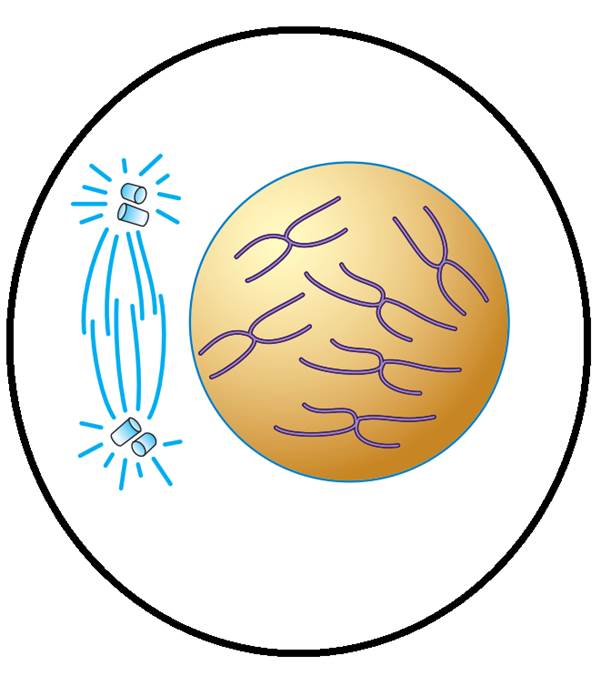
1. Prophase :
This phase involves:
condensation of chromatin material,
migration of centrosomes,
appearance of mitotic apparatus and
disappearance of nuclear membrane.
Due to condensation, each chromosome becomes visible under light microscope which can be seen with its sister-chromatids connected by centromere.
The nucleolus starts to disappear.
Nuclear membrane disintegrates and disappeares gradually.
Centrosome which had undergone duplication during interphase begins to move towards opposite poles of the cell.
Mitotic apparatus is almost completely formed.
2. Metaphase :
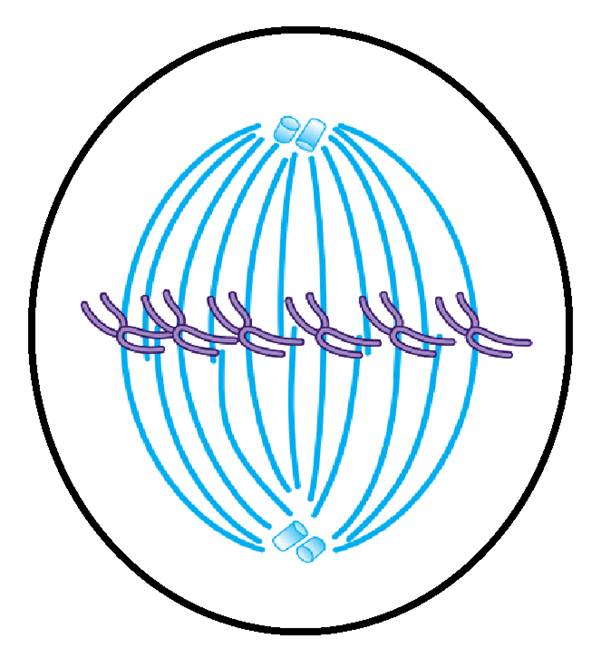
In this phase, chromosomes are completely condensed so that they appear very short.
Sister-chromatids and centromere become very prominent.
All the chromosomes lie at equatorial plane of the cell.
This is called metaphase plate.
Mitotic spindle is fully formed.
Centromere of each chromosome divides into two, each being associated with a chromatid.
3. Anaphase :
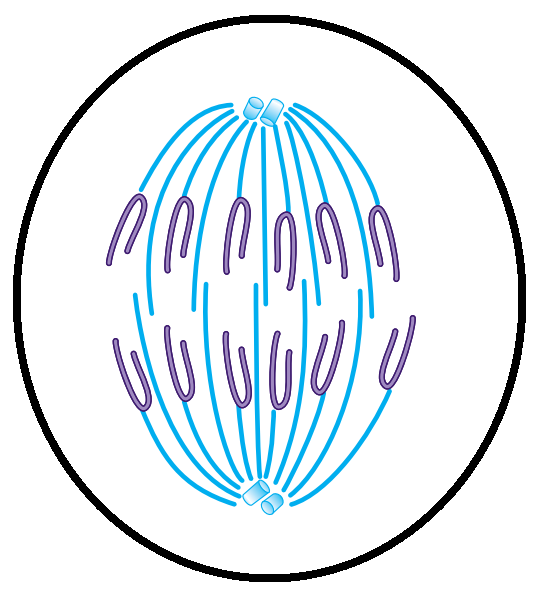
The chromatids of each chromosome separate and form two chromosomes called daughter chromosomes.
The formed chromosomes are pulled away in opposite direction by spindle apparatus.
Chromosomes being pulled away appear like a bunch of banana during midway of anaphase.
Each set of chromosomes reach at opposite poles of the cells marks the end of anaphase.
4. Telophase :
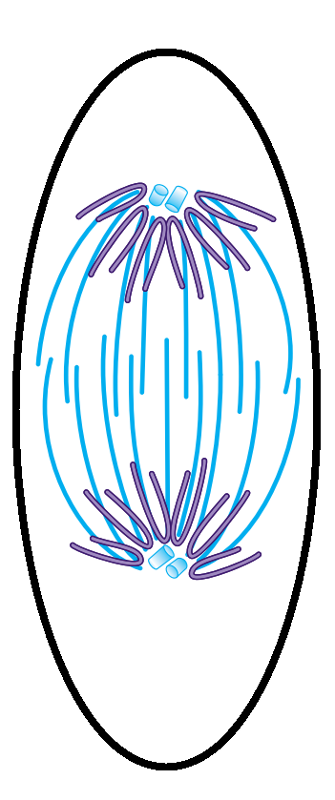
The telophase is the final stage of karyokinesis.
The chromosomes with their centromeres at the poles begin to uncoil, lengthen and loose their individuality.
The nucleolus begins to reappear.
The nuclear membrane begins to appear around the chromosomes. Spindle fibres break down and get absorbed in the cytoplasm.
Thus two daughter nuclei are formed in a cell.
Cytokinesis :
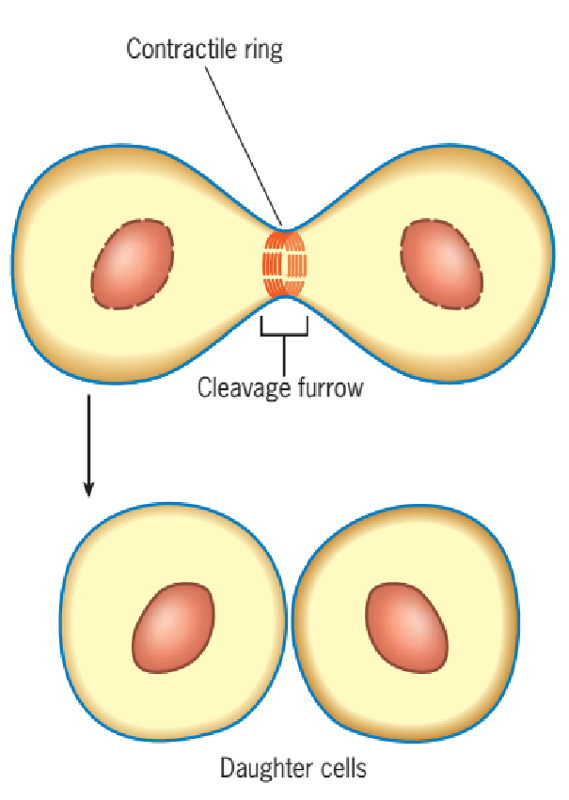
The division of the cytoplasm into two daughter cells is called cytokinesis.
The division starts with a constriction.
This constriction gradually deepens and ultimately joins in the centre dividing into two daughter cells.
This process of division of cytoplasm is perpendicular to the spindle.
This mechanism of cytokinesis is characteristic of animal cells.
However, plant cells are covered by a relatively non-flexible cell wall.
Due to this, furrow can not be formed.
Instead, cell wall/ partition starts to appear at the centre of the cell and grows outward to meet the existing lateral walls.
The formation of the new cell wall begins with the formation of a simple precursor, called the 'cell-plate'.
It represents the middle lamella between the walls of two adjacent cells.
At the time of cytoplasmic division, organelles like mitochondria and plastids get distributed between the two daughter cells.
Significance of mitosis :
As mitosis is equational division, the chromosome number is maintained constant.
It ensures equal distribution of the nuclear and the cytoplasmic content between the daughter cells, both quantitatively and qualitatively.
The hereditary material (DNA) is also equally distributed.
It helps in the growth and development of organisms.
Old and worn-out cells are replaced through mitosis.
It helps in the asexual reproduction of organisms and vegetative propagation in plants.
The process of mitosis also maintains the nucleo-cytoplasmic ratio.
Although mitosis is a very reliable process for preserving the genetic make-up of cells or organisms, it cannot introduce variation or new combination of existing genes.
