B. Second meiotic division or Homotypic Division (Meiosis II)
During this division, two haploid cells formed during first meiotic division divide further into four haploid cells.
This division is similar to mitosis.
The daughter cells formed in second meiotic division are similar to their parent cells with respect to the chromosome number formed in meiosis-I. Hence this division is called homotypic division.
It consists of the following phases : prophase-II, metaphase-II, anaphase-II, telophase-II and cytokinesis-II.
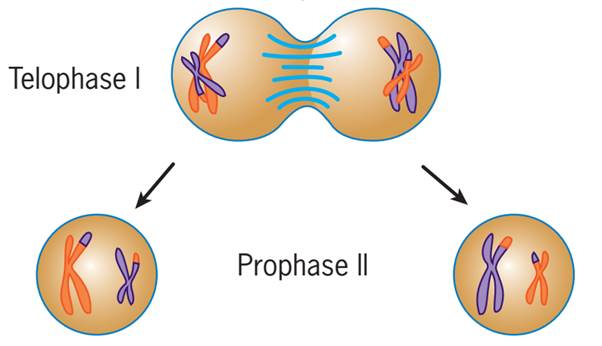
Prophase-II :
The chromosomes are distinct with two chromatids.
Each centriole divides into two resulting in the formation of two centrioles which migrate to opposite poles and form asters.
Spindle fibres are formed between the centrioles.
The nuclear membrane and nucleolus disappear.
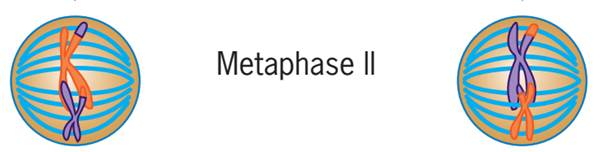
Metaphase-II :
Chromosomes gets arranged at the equator.
The two chromatids of each chromosome are separated by the division of the centromere.
Some spindle fibres are attached to the centromeres and some are arranged end to end between two opposite centrioles.
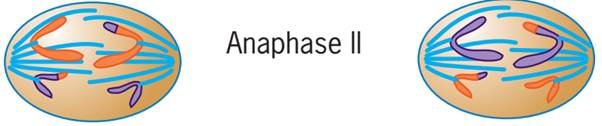
Anaphase-II :
The separated chromatids become daughter chromosomes and move to opposite poles due to the contraction of the spindle fibres attached to centromeres.
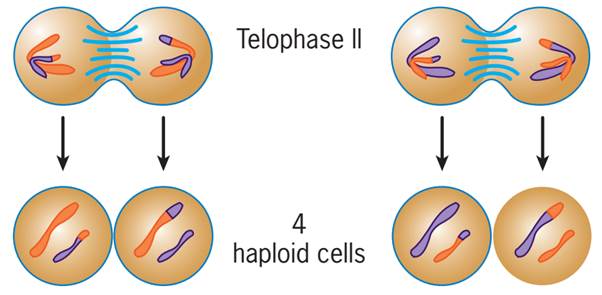
Telophase-II :
During this stage the daughter chromosomes uncoil.
The nuclear membrane surrounds each group of chromosomes and the nucleolus reappears.

Cytokinesis-II :
Cytokinesis occurs after nuclear division.
Two haploid cells are formed from each haploid cell. Thus, in all, four haploid daughter cells are formed.
These cells undergo further changes to develop into gametes.
Significance of Meiosis :
Meiotic division produces gametes.
If it is absent, the number of chromosome would double or quadruple resulting in the formation of monstrosities (abnormal forms).
The constant number of chromosomes in a given species across generations is maintained by meiosis.
Because of crossing over, exchange of genetic material takes place leading to genetic variations, which are the raw materials for evolution.
