3.2 Salient features of major plant groups under Cryptogams:
A. Division : Thallophyta
Members are mostly aquatic, few grow on other plants as epiphytes.
Some grow symbiotically and epizoic i.e. growing or living non-parasitically on the exterior of living organisms.
Aquatic algae grow in marine or fresh water.
Most of them are free living while some are symbiotic.
Plant body is thalloid i.e. undifferentiated into root, stem and leaves.
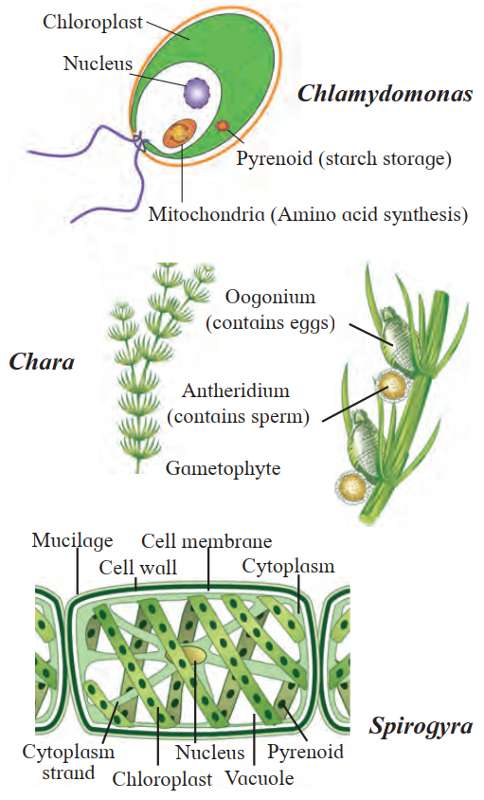
They may be small, unicellular, microscopic like Chlorella (nonmotile), Chlamydomonas (motile).
They can be multicellular, unbranched, filamentous like Spirogyra or branched, filamentous like Chara.
Sargassum, a huge macroscopic sea weed which measures more than 60 meters in length is also an alga.
The algal cell wall contains either polysacchrides like cellulose / glucose or a variety of proteins or both.
Reserve food is in the form of starch and its other forms.
Reproduction takes place by vegetative asexual and sexual way.
The life cycle shows phenomenon of alternation of generation, dominant haploid and reduced diploid phases.
Algae are classified as per its pigments like chlorophyll, Xanthophylls and phycobilin.
a. Chlorophyceae (green algae) :
Characteristics:
- Mostly fresh water; few are brackish water or marine
- Plant body: unicellular, colonial, or filamentous
- Cell wall contains cellulose
- Chloroplasts: various shapes (discoid, plate-like, reticulate, cup-shaped, ribbon-shaped, spiral)
- Photosynthetic pigments: Chlorophyll a and b
- Reserved food: true starch
- Pyrenoids: located on chloroplast; rich in protein (used as food, even by space travelers)
Examples: Chlorella, Chlamydomonas, Spirogyra, Chara, Volvox, Ulothrix
Key Features of Common Green Algae:
- Chlorella: Non-motile, unicellular
- Chlamydomonas: Motile, unicellular
- Spirogyra: Unbranched, filamentous with spiral chloroplast
- Chara: Branched, filamentous
b. Phaeophyceae (Brown algae):
Characteristics:
- Habitat: Mostly marine, rarely fresh water
- Plant body: Simple branched or filamentous (e.g., Ectocarpus); profusely branched (Petalonia)
- Cell wall: Contains cellulose, fucans, and algin
- Photosynthetic pigments: Chlorophyll-a, -c, and fucoxanthin
- Reserved food: Mannitol, laminarin, and starch
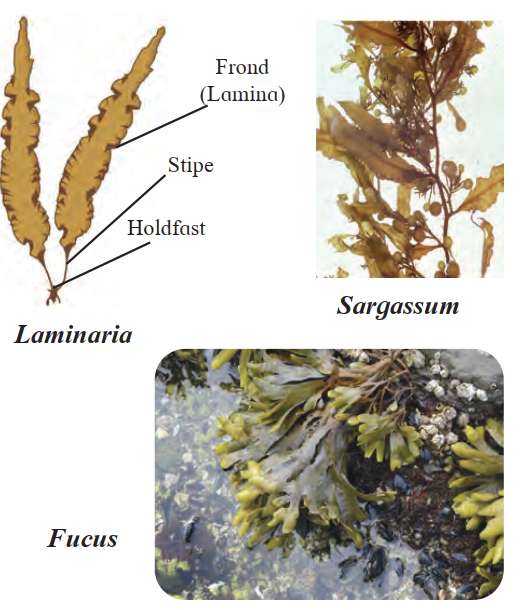
- Body structure: Differentiated into:
- Holdfast - anchoring structure
- Stipe - stalk-like structure
- Frond - leaf-like photosynthetic organ
Economic Importance:
- Many species used as food (e.g., Laminaria, Sargassum)
- Used for production of hydrocolloids (e.g., Ectocarpus, Fucus)
Notable Species:
- Brown algae (kelps) may grow up to 100 meters in height
- Sargasso sea contains vast brown algae forests
Examples: Laminaria, Sargassum, Fucus, Ectocarpus, Petalonia
c. Rhodophyceae (Red algae) :
Characteristics:
- Habitat: Marine and fresh water (surface, deep sea, brackish water)
- Plant body: Thalloid
- Photosynthetic pigments: Chlorophyll a, d, and phycoerythrin
- Cell wall: Made of cellulose and pectin glued with other carbohydrates
- Reserved food: Floridean starch
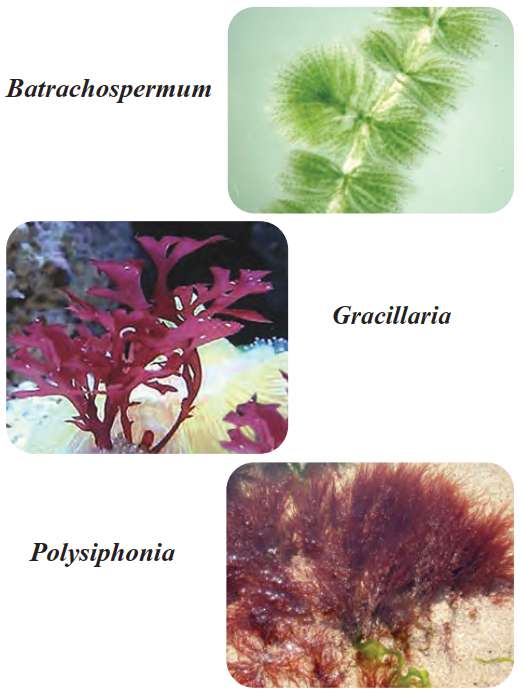
- Distinguishing feature: Deep red color due to phycoerythrin pigment
Commercial Importance:
- Agar-agar: Used as solidifying agent in tissue culture medium (obtained from red algae)
- Highly valuable in biotechnology
Examples: Chondrus, Batrachospermum, Porphyra, Gelidium, Gracillaria, Polysiphonia
Can you Tell ?

|
Feature |
Chlorophyceae |
Phaeophyceae |
Rhodophyceae |
|
Habitat |
Fresh water (few marine) |
Marine (rarely fresh) |
Marine & Fresh water |
|
Pigments |
Chl a & b |
Chl a, c & Fucoxanthin |
Chl a, d & Phycoerythrin |
|
Cell Wall |
Cellulose |
Cellulose, fucans, algin |
Cellulose & Pectin |
|
Reserved Food |
True starch |
Mannitol, laminarin, starch |
Floridean starch |
|
Examples |
Spirogyra, Chara, Volvox |
Sargassum, Laminaria, Fucus |
Gracillaria, Porphyra |
