There is great diversity of organisms around us. Since time immemorial, we humans have been exploiting this wealth for our own benefit. During this process man tried to differentiate between and identify the organisms.
Eventually this evolved into a branch of biology known as systematics or classification.
The methods of classification dates back to ancient time when Indian, Greek and Roman philosophers have contributed their might to systematise science.
2.1 Systematics
"Systematics is the study of kinds and diversity of organisms and their comparative and evolutionary relationship" (G. Simpson, 1961).
Taxonomy
Taxonomy classification following certain rules or principles. Word Taxonomy comes from two Greek words, taxis - meaning arrangement and nomous meaning law or rule.
The term taxonomy was first introduced by A. P. de Candolle (Swiss Botanist) [1778-1841].
2.2 Classification :
It is the arrangement of organisms or groups of organisms in distinct categories in accordance with a particular and well established plan.
This classification is based on similarities and dissimilarities among the organisms.
1. Artificial Classification
It is the classification that is based on few easily observable and non-evolutionary feature such as habit, colour, form, etc.; often irrespective of their affinity (relationship) with other organisms.
e.g. Linnaeus system of classification.

2. Natural Classification:
It is the classification which is based on objectively significant rather than being selected for convenience like artificial system of classification
e.g. Bentham and Hooker's system of classification.
3. Phylogenetic Classification
It is the classification based on common evolutionary descent.
e.g. Engler and prantles classification.
In the system of classification the terms like 'taxa' and 'categories' are often used. Each category is referred to as a unit of classification. In fact, it represents a rank and is commonly termed as taxon.
2.3 Three domains of life :
It is believed that the life originated on earth in its very simple form.
Constant struggle of the early living beings gave rise to more and more perfect forms of life. This struggle and progress is evolution which led to formation of diverse life forms.
Carl Woese in 1990 proposed three domains of life to classify life forms.
They are Archaea, Bacteria and Eukarya.
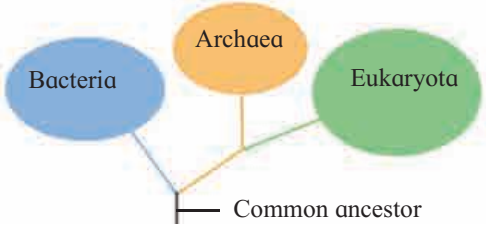
Domain is an unit larger than Kingdom in the system of classification.
Bacteria and Archaea both have prokaryotic cells where as Eukarya have eukaryotic cell.
All the three domains have very unique ribosomal RNA (rRNA).
Archaea are known for their survival in very extreme conditions like high tempreature, salinity, acidic conditions, etc.
Bacteria, though are prokaryotes differ from Archaea in structure of cell wall.
2.4 Chemotaxonomy :
It is method of biological classification based on similarities and differences in structure of certain compounds present among the organisms being classified.
In short, it is the classification based on chemical constituents of organisms,
e.g. Archaea cell wall is without peptidoglycan and that of Prokarya is with peptidoglycan.
Among Eukarya, fungi have chitinous cell wall while plants have cellulosic cell wall.
2.5 Numerical taxonomy :
The system is based on quantification of characters and develops an algorithm for classification.
The basic aim of this taxonomy was to create a taxonomy using numeric algorithms like cluster analysis rather than using subjective evaluation of their propertise.
This system was first proposed by Sokel and Sneath in 1963.
2.6 Cladogram :
It is a typical branching pattern. As shown on previous page, a diagram of three domains of life is a cladogram.
It represents a hypothetical relationship denoting a comparison of organisms and their common ancestors.
2.7 Phylogeny :
It is evolutionary relationship of organism.
It is an important tool in classification as it takes into account not merely the morphological status but also the relationship of one group of organism with other groups of life.
The system helps to understand the evolution and also focuses on the similarities of their metabolic functioning.
Woese's three domain concept as well as Whittakar's five kingdom system are very good examples of phylogenetic relationship.
2.8 DNA barcoding :
DNA barcoding, is a new method for the identification of any species based on its DNA sequence from a tiny tissue sample of the organism under study.
It helps to study newly identified species as well as understanding ecological and evolutionary relationships between living beings. The process of DNA barcoding includes two basic steps:
(a) collecting DNA barcode data of known species and
(b) matching the barcode sequence of the unknown sample against the barcode library for identification.
DNA barcoding has many applications.
A few to mention are, protection of endangered species, preservation of natural resources, pest control in agriculture, identifying disease vectors; authentication of natural health products and identification of medicinal plants.