2.9 Taxonomic Categories :
Classification is not a single step process but involves hierarchy of steps in which each step represents a rank or category. Since the category is a part of overall taxonomic arrangement it is called taxonomic category and all categories together constitute the taxonomic hierarchy.
Kingdom, division, class, order, family, genus, species are the categories in hierarchical sequence.
These are compulsory categories. Besides, there are some facultative categories like sub-order, sub-family, etc. to be used as per need.
2.10 Taxonomic Hierarchy :
Taxon : A taxon is the taxonomic group of any rank in the system of classification (H.J. Lam 1948) e.g. in plant kingdom each one of the following such as Angiosperms, Dicotyledonae, Malvaceae represents a taxonomic group i.e. a taxon.
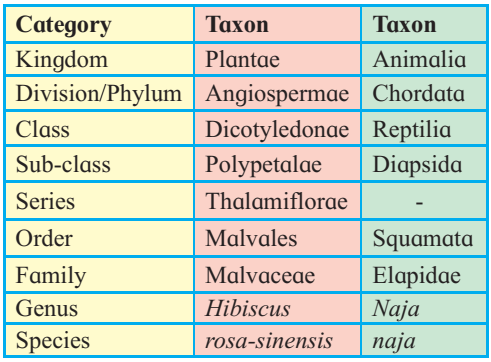
Classification of China-rose and Cobra.
2.11 Units of Classification :
Species :
Species is the principal natural taxonomic unit, ranking below a genus and denoted by latin binomial (considered as the basic) unit of classification.
It is a group of organisms that can interbreed under natural condition to produce fertile offspring. It was thought to be an indivisible, stable and static unit. However in the modem taxonomy, subdivision of species such as sub-species, varieties of populations are seen and given more importance..

Genus :
Genus is a taxonomic rank or category larger than species used in the biological classification of living and fossil organisms.
Genus is a group of species bearing close resemblance to one another in their morphological characters but they do not interbreed.
e.g. Tiger, Leopard, Lion all three belong to same genus Panthera. They have common characters yet are different from each other because their genus is same but species is different.
Another example is genus Solanum. Brinjal and potato both belong to this genus.
Family:
It is one of the major hierarchial taxonomic rank.
A family represents a group of closely related genera, e.g. genera like Hibiscus, Gossypium, Sida, Bombax are included in same family Malvaceae.
Cat also belongs to family of leopards, tigers and lions, family Felidae but dog belongs to different family Canidae.
Cohort / Order :
It is taxonomic rank used in the classification of organisms and recognised by nomenclature codes.
An order is a group of closely related families showing definite affinities.
Order thus is a step above family in taxonomic hierarchy. Members belonging to same order but different families may show very few dis-similarities,
e.g. family - Papaveraceae, Brassicaceae, Capparidaceae, etc with parietal plancentation are grouped in order Parietales.
Families of dogs and cats though are different, they belong to same order Carnivora.
Sub-kingdom :
Different divisions having some similarities form sub-kingdom,
e.g. The divisions Angiospermae and Gymnospermae will the sub-kingdom Phanerogams or Spermatophyta.
Kingdom :
It is the highest taxonomic category composed of different subkingdoms.
e.g. sub-kingdom Phanerogams and Cryptogams form the Plant kingdom or Plantae which includes all the plants while all animals are included in kindom Animalia.
The taxonomic categories we have considered so far are broad categories. Scientists have added sub-categories to these in order to place organisms in more scientific manner. You will observe that as we go higher in taxonomical ladder, number of common characters go on decreasing. If we are comparing two organisms that are related to each other only at division or phylum level, their classification may become difficult.
