Acellular organisms :
a. Viruses :
Viruses were named so by Louis Pasteur; considering the meaning, Venom or poison.
These obligate parasites were given the name 'virus' by M. J. Beijernek, after observation that they were able to migrate in an agar gel. Thus, being and infectious soluble agent, he called the filtrate as 'contagium vivum fluidum'.
It was scientist Stanley who demonstrated that viruses are inert outside the host cell and can be crystallised.
They are made up of proteins.
Viruses lack their own cell machinery.
They have protein coat (capsid) around nucleic acid strand, thus considered to be acellular organisms.
Viruses are inactive outside a host cell; but once they enter their specific host cell, they take charge of cellular machinery of host cell and duplicate themselves.
Viruses thus can be called infectious nucleoprotein particles.
Types of viruses :
As per genetic material, viruses are grouped as DNA or RNA viruses.
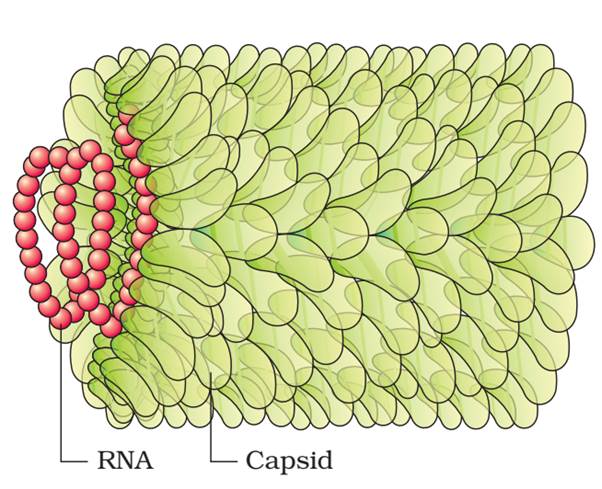
Protein coat called capsid is made up of smaller units, the capsomeres.
Capsomeres are arranged in polyhedral or helical forms.
Capsid protects genetic material.
The genetic material in viruses is either single-stranded RNA or single or doublestranded RNA or double-stranded DNA.
Viruses that infect bacterial cells are called bacteriophages which normally have doublestranded DNA.
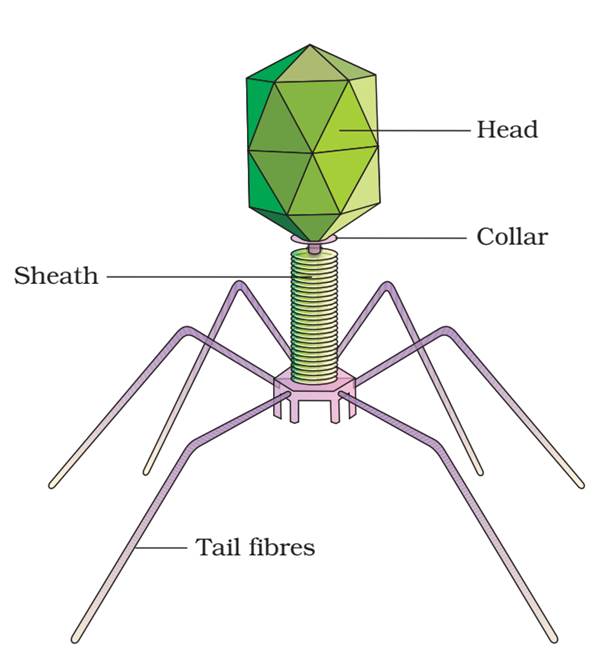
Viruses cause disorders like leaf curling, yellowing, mosaic formation etc. in plants.
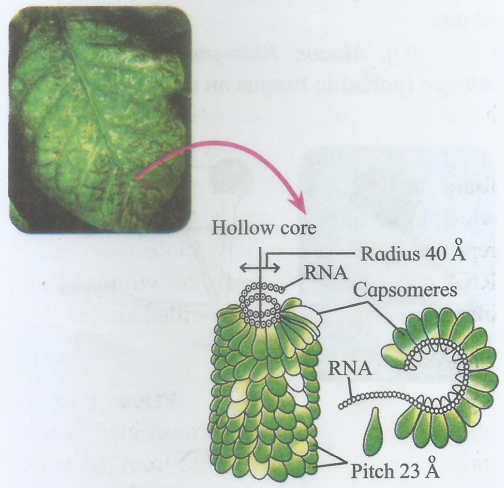 Tobacco Mosaic Virus (TMV)
Disease caused by viruses are
1. Foot and mouth disease in animals
2. Swine flu.
3. Small pox,
4. Mumps,
5. Herpes
6. Common cold
7. AIDS
b. Viroids
Potato spindle tuber disease was found to be caused by single stranded RNA which lacks protein coat.
T. O. Diener in 1971 reported that this is low molecular weight RNA and smaller in size than viruses.
These infectious RNA strands are called viroids.
c. Lichens:
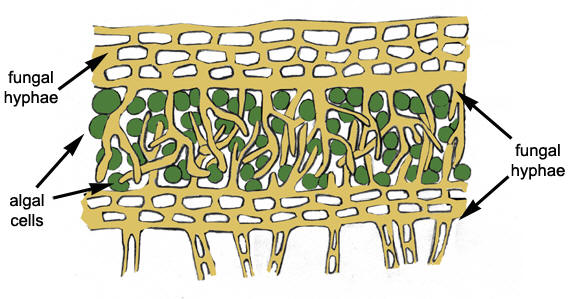
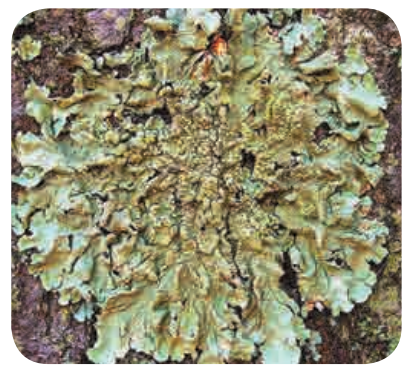
Lichen is co-existence of algae and fungi for mutual benefit.
Algal member, the phycobiont as it is called, mostly belongs to cyanobacteria (blue-green algae) or green algae.
Fungal member is called mycobiont.
They are excellent example of symbiosis.
The algal component of lichens provides food to fungal part while fungus provides shelter to alga and also absorbed water and minerals to alga.
The association is intense and it is difficult to identify them as separate living beings.
Though found in extreme environments like snow clad poles, lichens are sensitive to pollution.
They are not found in polluted regions, hence are considered as pollution indicators.
Lichens also play important role in soil formation by using specific acid productions.
Prions :
In modern medicine, certain infectious neurological diseases were found to be transmitted by abnormally folded proteins.
These proteins are called prions.
The word prion comes from 'proteinaceous infectious particle'. e.g. mad cow disease in cattle, Jacob's disease in human.
More information of Prions - Click here
