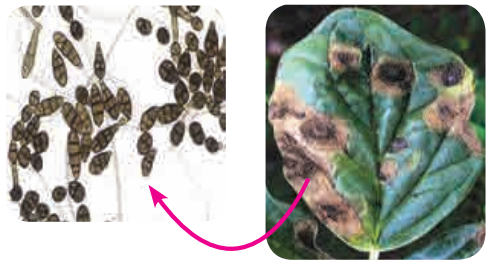
4. Kingdom Fungi :
These are eukaryotic heterotrophs showing extracellular digestion.
They are found in warm and humid places.
They have simple body which may be unicellular or made up of long thread like structures called hyphae.
Large fungi such as mushrooms have a compact mass of cells.
Unicellular organisms have a protoplast with many nuclei
e.g. Rhizopus, Saccharomyces (Yeast-unicellular fungus).
Filamentous fungi consist of a body called mycellium in which hyphae are present.
The hyphae may be with septa or without septa.
They may be uni or multinucleate.
The non-septate multinucleate hyphae are called coenocytic hyphae.
The cell wall in fungi is composed of chitin, a polysaccharide or fungal cellulose.
The fungi exhibit hetrotrophic mode of nutrition. Mostly they are saprophytic, some are parasitic or predators.
They reproduce sexually as well as asexually.
Asexual reproduction takes place by fragmentation, fission and budding.
Some fungi are symbiotic; either live with algae aslichens or as mycorrhiza in association with roots of higher plants.
They are useful as well as harmful.
Mushrooms are consumed as food, yeast is used in bakery and breweries.
Penicillium, a fungus, is well known for antibiotic production.
Harmful fungi cause diseases in plants and animals, e.g. Puccinia.
The fungi are further classified on the basis of their structure, mode of spore formation and fruiting bodies as follows-
a. Phycomycetes :
These are commonly called algal fungi.
Mycelium is made up of aseptate coenocytic hyphae.
They commonly grow in moist and damp habitats, on decaying organic matter as well as in aquatic habitats or as parasites on plants.
e.g. Mucor, Rhizopus (bread mould), Albugo (parasitic fungus on mustard).
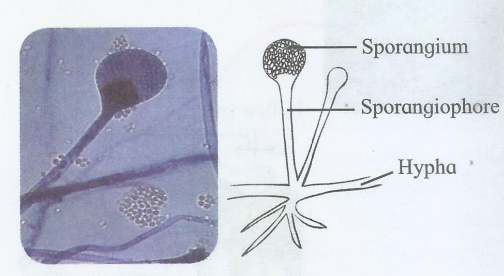 Mucor
Mucor
b. Ascomycetes:
These are called as sac-fungi.
These fungi are mostly multicellular. Rarely unicellular varieties include yeast.
The hyphae are branched and septate.
Sac fungi can be decomposers, parasites or coprophilous (grow on dung).
Morels and truffles are varieties of sac fungi that are consumed as delicacies.
Neurospora is useful in genetic and biochemical assays.
Ex. Aspergillus, Penicillium, Claviceps, Neurospora, Saccharomyces.
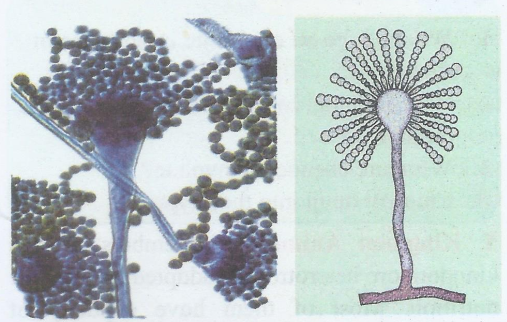 Aspergillus
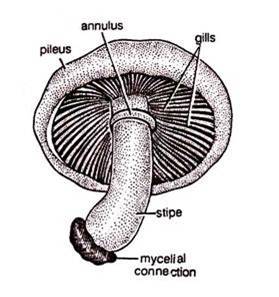
c. Basidiomycetes :
These are commonly called club fungi.
They have branched, septate hyphae.
e.g. Agaricus (mushrooms), Ganoderma (bracket fungi), Ustilago (smuts), Puccinia (rusts), etc.
d. Deuteromycetes :
These are called imperfect fungi, which are known to reproduce only asexually.
e.g. Alternaria, Colletotrichum.