2. Kingdom Protista:
This group includes all the unicellular but eukaryotic organisms. These organisms show link with all eukaryotic Kingdoms like Plantae, Fungi and Animalia.
a. Plant like protista:
- They are also termed Chrysophytes.
- They are commonly termed phyto-planktons.
- They are microscopic and mostly photosynthetic and are major producers in oceans.
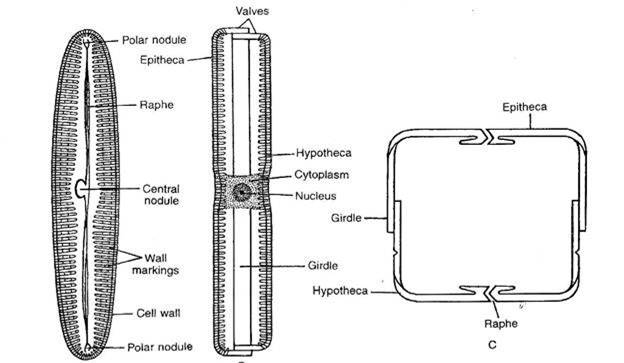
- Most of them are referred to as diatoms as the have body wall made up of two soap-box like fitting silica covers.
- "Diatomaceous earth" is nothing but these shells left behind for so many years. Diatomaceous earth is granular hence finds use in polishing and filtration.
b. Animal like Protista
- They are also termed protozoans.
- They lack cell wall.
- They are heterotrophs.
- They are believed to be primitive animal forms.
- Amoeboid protozoans have pseudopodia as locomotory organs. Amoeba is free living form but Entamoeba is endoparasite and causes amoebic dysentery.
- Flagellated protozoans have flagella as locomotory organ. Trypanosoma is a common flagellated pathogen which causes sleeping sickness.
- Paramoecium is a cilliate protozoan having cilia for locomotion. In Paramoecium, gullet (a cavity) opens on the cell surface.
- Plasmodium is a sporozoan protozoa. It causes malaria. It forms spores in one of its life stage.
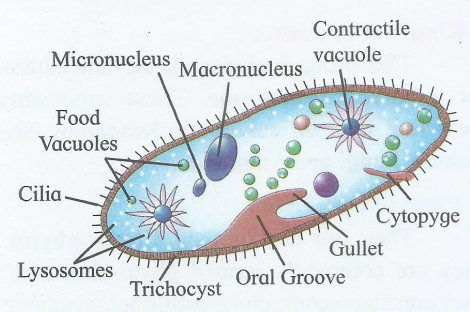 Paramoecium
c. Dinoflagellates
- These are aquatic (mostly marine) and photosynthetic.
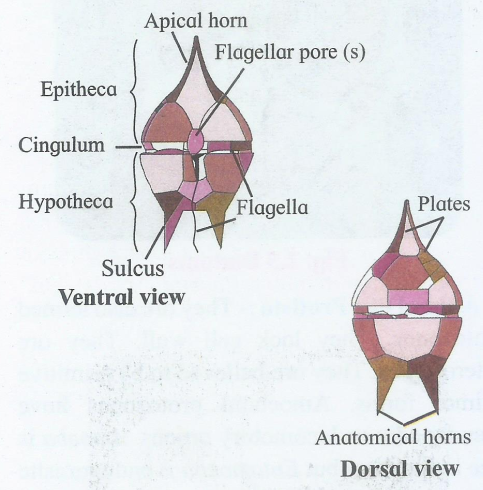
- The cell wall is made up of cellulosic stiff plates.
- They possess a pair of flagella.
- They have a wide range photosynthetic pigments, which can be yellow, green, brown, blue and red.
- Gonyaulax is dinoflagellate that is responsible for famous 'red tide'. It makes even sea appear red.
d. Fungi like protista :
- They are commonly from the group Myxomycetes.
- These are saprophytic organisms found on decaying leaves.
- Their cells aggregate to form a large cell mass called plasmodium (not a malaria parasite).
- The spores produced by plasmodium are very tough and survive even very harsh conditions.
e. Euglenoids
- They lack cell wall but have a tough covering of proteinaceous pellicle.
- They possess two flagella, one short and other long.
- They behave as heterotrophs in absence of light but possess pigments, similar to that of higher plants, for photosynthesis.
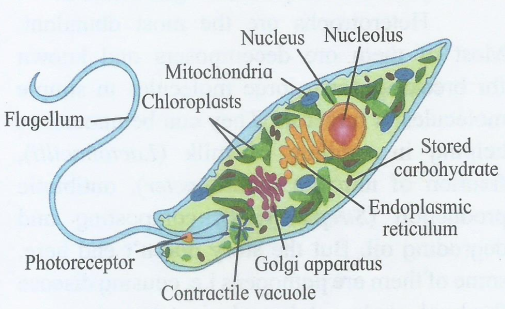 Euglena
