RESPIRATION - INTRODUCTION:
Complex organic substances (food) store large amount of energy in the chemical bonds.
This is basically light energy (solar energy) converted into chemical energy by the process of photosynthesis.
The breaking of complex organic substances through oxidation releases the energy. This process is called respiration.
All living organisms require energy to carry out various activities.
This energy is obtained through respiration which is a catabolic process.
Respiration is defined as an intracellular process of oxidation in which complex organic substances are broken down in step wise manner.
The release of energy is immediately converted into metabolically usable form of energy that is ATP.
Approximately, 40% of the released energy is conserved as chemical energy in the form of ATP molecules and rest is lost in the form of heat that maintains body temperature of the living organism.
Carbon dioxide and water is released as a byproduct.
Various types of food materials, complex organic substances, are forms of potential energy and are used as respiratory substrates.
They include carbohydrates, proteins, fats, organic acids, etc.
Carbohydrates are the main source of energy and glucose is the most preferred substrate because it is easily available and acceptable to all kinds of organisms.
ATP AS CURRENCY OF ENERGY:
ATP or adenosine triphosphate is an energy-rich organic compound.
It stores energy released during respiration in its high-energy chemical bonds.
This energy is made available for various cellular activities.
The cell needs energy for its division, growth, movements, reproduction, various biosynthetic processes, etc.
Whenever the cell needs energy, ATP is hydrolyzed to produce ADP (adenosine diphosphate) and Pi (inorganic phosphate) and energy is released as high energy phosphate bond is broken.
Chemically, ATP is a triphosphate ester of ad-enosine ribonucleoside.
It has three chemical components namely,
1. Nitrogenous purine base called adenine,
2. A pentose sugar called ribose (C5H10O5)
3. Three phosphate groups.
Adenine + ribose = adenosine - "a ribonucleoside".
To this, three phosphate groups can be added as follows:
- Adenosine + phosphate = Adenosine mono-phosphate (AMP),
- Adenosine monophosphate + phosphate =Ad-enosine diphosphate (ADP), and
- Adenosine diphosphate + phosphate = Adenos-ine triphosphate (ATP)
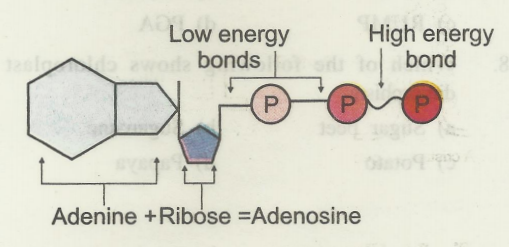
The two terminal phosphates are linked by high energy bond.
The energy released from the high energy bond is ~ 7.3 kcal.
The energy is stored in from of ATP and derived from its hydrolysis. The hydrolysis results in formation of ATP and inorganic phosphate.
Site for ATP synthesis
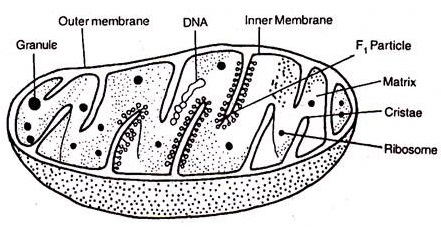
Mitochondrion is a double membrane bound structure.
Outer membrane is smooth and tightly stretched.
Inner membrane has finger-like projection called cristae which encloses colorless matrix.
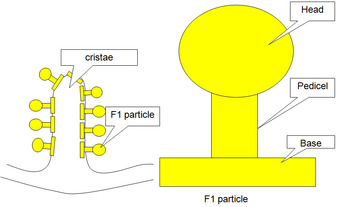
Each crista bears numerous stalked particles called as F1-particles or elementary particles or oxysomes.
The electron carriers of ETS and Enzyme required for ATP synthesis [ATP synthase] are located on body of oxysomes.
Oxysome is site of Oxidative phosphorylation.
Mitochondrial matrix contains enzymes for Krebs cycle.
It has 70S type of ribosome and single circular DNA molecule.
Thus, Mitochondria are self-duplicating, semi-autonomous cell organelles.
