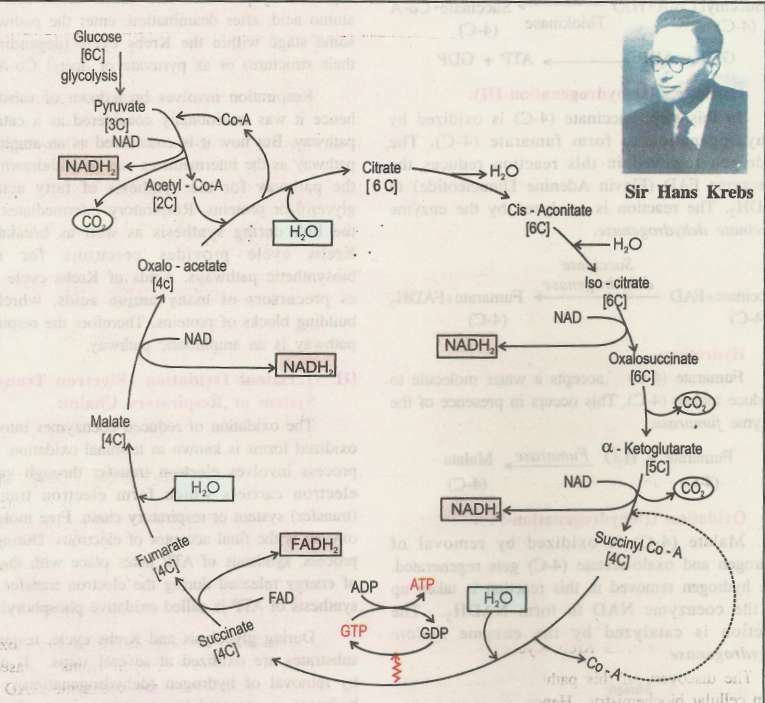
II. Krebs cycle [Citric Acid Cycle / TCA Cycle]
The cyclic process through which acetyl co-A is completely oxidized and CO2 is released in step wise manner, is called Krebs cycle.
It is the second phase in the mechanism of aerobic respiration.
It occurs in the matrix of mitochondria, in presence of several enzymes and coenzymes.
During this phase, co-enzymes NAD and FAD take up the H2 removed during oxidation steps and NADH2 and FADH2, are formed.
It involves a series of reactions, each catalyzed by a specific enzyme.
The first stable compound of Krebs cycle is citric acid (6-C) or citrate. Chemically it is a tricarboxylic acid. Hence Krebs cycle is also called citric acid cycle or tri-carboxylic acid cycle or TCA cycle.
Various reactions of TCA cycle were discovered by Sir Hans Krebs in 1937.
Therefore, it is popularly known as Krebs cycle.
The discovery of this pathway opened a new era in cellular biochemistry. Hence, Sir Hans Krebs was awarded Nobel Prize in Biochemistry' in 1953.
Citrate, the first product of cyclic reactions undergoes many changes;
there are
four oxidation (dehydrogenarion) and
two decarboxylation steps
and finally the initial acceptor of Acetyl Co-A, oxalo-acetate is regenerated.
Acetyl fraction (2-C) is completely oxidized.
Major reactions of Krebs cycle are as follows:
1. Condensation:
Acetyl coenzyme-A reacts with oxalo-acetate which is a 4-C compound present in matrix of mitochondrion and a 6-C compound called citric acid or citrate is formed
Thus citrate is the first stable compound of Krebs cycle.
One water molecules is used in this reaction.
The enzyme citrate synthetase catalyses the reaction.
Co-A - thus relieved - is recycled for acetylation of another molecule of pyruvate.
Citrate undergoes a series of biochemical reactions and finally oxalo-acetate gets regenerated.
It again reacts with a fresh molecules of acetyl coenzyme-A to repeat the cycle.
2. Isomerisation:
Citric acid gets converted into its isomer, isocitric acid in the presence of enzyme aconitase and Fe++.
This happens in two steps.
i) Dehydration:
Citrate loses a water molecules and cis-aconitate (6-C) is formed.
ii) Hydration:
Cis-aconitate combines with a water molecule to form iso-citrate, an isomer of citrate.
3. Oxidation (Dehydrogenation-I):
Iso-citrate (6-C) is oxidized to form oxalosuccinate (6-C).
Two hydrogen atoms released at this step are taken up by the coenzyme NAD and NADH2 is formed.
The enzyme iso-citrate dehydrogenase and Mn++ are necessary for this reaction.
4. Decarboxylation:- 1
Oxalo- succinate (6C) undergoes decarboxylation in the presence of enzyme decarboxylase and α-ketoglutarate (5C) is formed.
CO2 goes out of the mitochondria.
6. Hydration and Phosphorylation:
Succinyl coenzyme-A (4-C) gets hydrated using a molecule of water and succinate (4-C) is formed.
Energy liberated during this reaction is used in the formation of GTP from GDP (Guanosine Diphosphate - a substance like ADP) and Pi.
However, GTP is relatively unstable as compared to ATP. It is soon transformed to ATP using ADP.
The reaction takes place in presence of the enzyme succinate thiokinase. Such an ATP synthesis produced by the substrate without entering ETS (electron transport system) is called substrate level phosphorylation.
7. Oxidation (Dehydrogenation-III):
In this step, succinate (4-C) is oxidized by dehydrogenation to form fumarate (4-C).
The hydrogen removed in this reaction reduces the coenzyme FAD (Flavin Adenine Dinucleotide) to FADH2.
The reaction is catalyzed by the enzyme succinate dehydrogenase.
8. Hydration:
Fumarate (4-C) accepts a water molecule to produce malate (4-C). This occurs in presence of the enzyme fumarase.
9. Oxidation (Dehydrogenation-IV):
Malate (4-C) is oxidized by removal of hydrogen and oxalo-acetate (4-C) gets regenerated.
The hydrogen removed in this reaction is taken up by the coenzyme NAD to form NADH2.
The reaction is catalyzed by the enzyme malate dehydrogenase.
Summary
Two molecules of pyruvate are formed at the end of glycolysis.
Therefore, Krebs cycle is repeated twice for every glucose molecule oxidized aerobically.
Thus, two turns of Krebs cycle produce,
- six molecules of NADH2,
- two molecules of FADH2 and
- two molecules of ATP.
During each turn of Krebs cycle
- three molecules of water are used-up and
- two molecules of CO2 are released.