Anaerobic Respiration:
Incomplete oxidation of the respiratory substrate in the absence of oxygen to yield CO2 and ethyl alcohol is called anaerobic respiration.
It gives relatively less amount of energy
A number of bacteria and some fungi such as yeasts show anaerobic respiration.
It occurs in cytoplasm only and gives net gain of 2 ATP per glucose molecule.
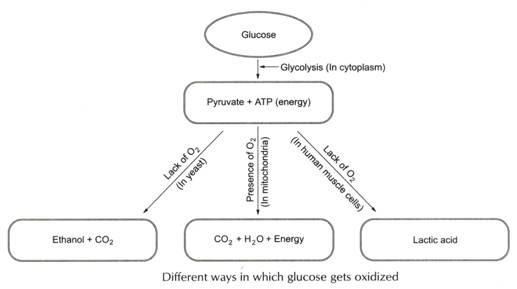
The mechanism of anaerobic respiration
- glycolysis,
- decarboxylation and
- reduction.
(i) Glycolysis:
Glycolysis or EMP Pathway is an anaerobic process and occurs in cytoplasm.
It is similar to that of aerobic respiration.
During glycolysis, each glucose molecule is broken down into two molecules of pyruvate with the formation of two molecules each of NADH2 and ATP.
It may be represented as follows:
C6 H12 O6 + 2NAD + 2 ADP + 2iP ————» 2 CH3 - CO - COOH + 2 NADH2 + 2 ATP
(ii) Decarboxylation:
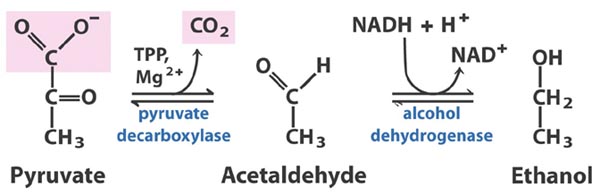
Pyruvate undergoes decarboxylation by removal of a CO2 molecule.
It occurs in presence of the enzyme pyruvate decarboxylase to give acetaldehyde.
Coenzyme thiamine pyrophosphate (TPP) and the cofactor Zn++ is necessary for this reaction.
(iii) Reduction:
Acetaldehyde is reduced to ethyl alcohol by the reduced coenzyme NADH2.
The reaction occurs in presence of the enzyme dehydrogenase.
NADH2 is oxidized to NAD.
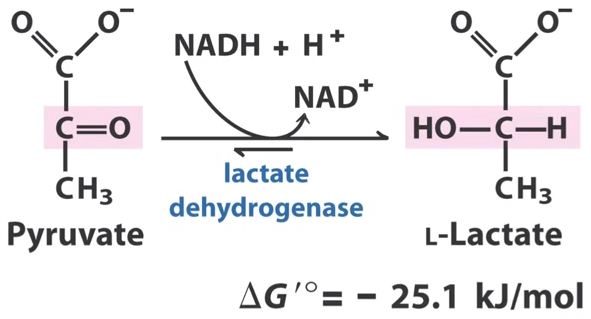
During anaerobic respiration by lactic acid bacteria, decarboxylation does not occur. Pyruvate directly undergoes reduction using NADH2 to produce lactic acid.