Fermentation:
The term fermentation is derived from Greek word fervos meaning bubbling
Fermentation can be defined as a chemical change brought about in an organic substrate due to the activity of micro-organisms or enzymes produced by the microorganisms.
Alcoholic Fermentation
In case of alcoholic fermentation,
sucrose (molasses) is converted into alcohol.
Yeast or only the group of enzymes collectively called zymase can bring about the alcoholic fermentation of sucrose.
The first step is hydrolysis, in which sucrose is hydrolysed into glucose and fructose as follows:
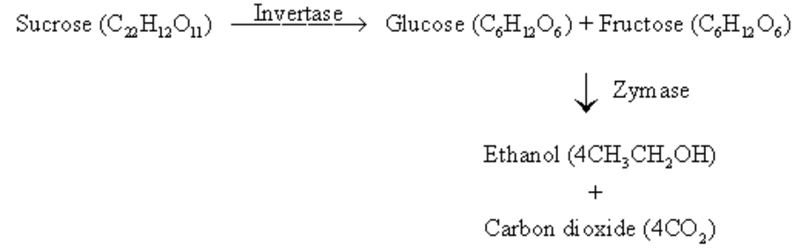
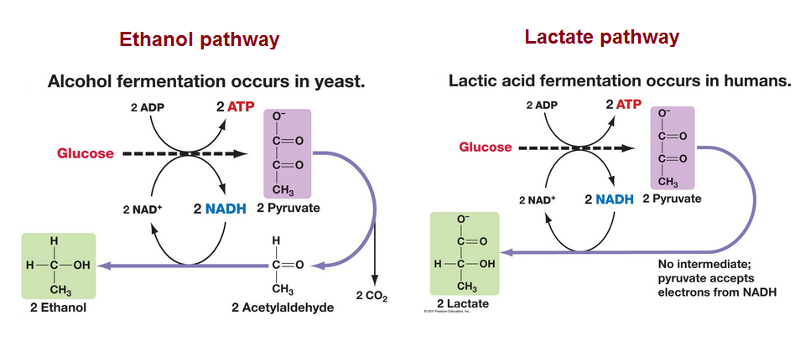
Second step is glycolysis followed by decarboxylation and reduction as in anaerobic respiration.
Lactic Acid Fermentation
In case of lactic acid fermentation
milk sugar lactose is converted into lactic acid.
The first step is hydrolysis of lactose (disaccharide) into glucose and galactose, which is followed by glycolysis and reduction. (There is no decarboxylation).
Thus, fermentation is similar to anaerobic respiration but it can be extra cellular or intracellular.
Antibiotics and Vitamins
In fermentation industries for the production of antibiotics and vitamins specific micro-organisms are used.
Antibiotics and vitamins are the secondary metabolites.
- Antibiotics are released in the fermenter
- vitamins are produced intracellularly and the microbial cells are to be autolysed to release the vitamins in the fermenter.
For production of vitamins aeration is required as aerobic micro-organisms are used.
Thus fermentation can be aerobic or anaerobic process.
Exchange of gases
Animals have respiratory organs, we breath in O2 and breath out CO2.
What about plants? Do they breath like us? Plants do require O2 for respiration to occur and they also give out CO2, but they do not have specialized organs for gaseous exchange.
They have stomata and lenticels for this purpose.
Plants take care of their own gas-exchange needs. There is very little transport of gases from one plant part to another.
Roots, stem and leaves respire at very low rates as compared to animals.
(Only germinating seeds and floral buds show comparatively higher rates and are therefore used to demonstrate respiration.)
Plants do not show great demands for gas exchange.
During photosynthesis, large volumes of gases are exchanged and leaves are well adopted to carry out exchange of gases.
Leaf anatomy is ideal for photosynthesis. In plants, each living cell is located quite close to the surface of the plants.
When cells photosynthesize, availability of O2 is not a problem.
In stems, living cells are beneath the bark, and bark is with openings called lenticels.
The loose packing of parenchyma cells in stems and roots provide interconnected network of air spaces and transport of gases is facilitated.
