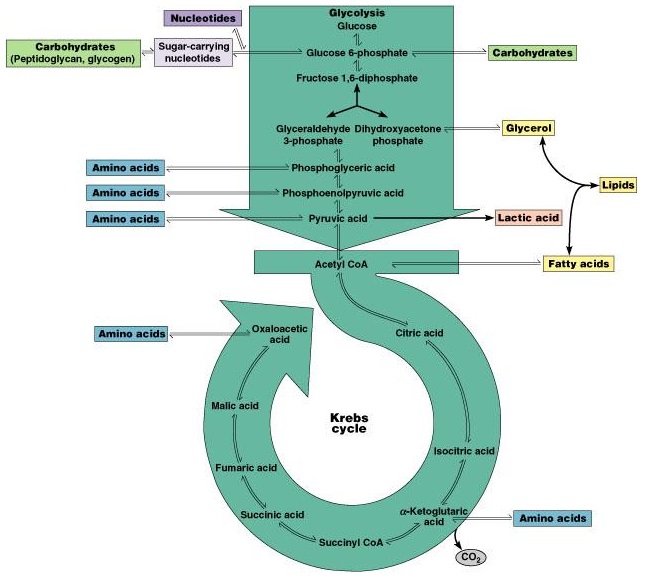
Amphibolic Pathway:
When fats are the respiratory substrate,
- they are first broken down into glycerol and fatty acids.
- Glycerol is converted into DHAP first, then PGAL and then acetyl Co-A.
Fatty acids are also first degraded to acetyl Co-A, and then enter the Krebs cycle.
The proteins are degraded by proteases into amino acids,
- individual amino acid, after deamination,
- It enters the pathway at some stage within the Krebs cycle (depending on their structure) or as pyruvate or acetyl Co-A.
Respiration involves breakdown of substrates, hence it was traditionally considered as Catabolic pathway.
But now it is considered as an amphibolic pathway
- as the intermediates can be withdrawn from the pathway for the synthesis of fatty acids or glycerol or proteins.
Respiratory intermediates form the link during synthesis as well as breakdown.
Krebs cycle provides precursors for many biosynthetic pathways.
Acids of Krebs cycle serve as precursors of many amino acids, which are building blocks of proteins.
Therefore the respiratory pathway is an amphibolic pathway.