Glycolysis (EMP Pathway):
(Glyco = glucose; lysis = splitting or break-down)
Glycolysis is the first major process in the mechanism of aerobic respiration.
It is an anaerobic process since it is independent of oxygen.
It takes place in cytoplasm hence also called cytoplasmic respiration.
It is common pathway for aerobic as well as anaerobic respiration.
Various steps in glycolysis are controlled by specific enzymes.
Glycolysis is defined as the stepwise, enzymatic break-down of the hexose sugar (glucose) into two molecules of pyruvate in cytoplasm.
Various steps and reactions of glycolytic pathway were worked out by three German biochemists, namely, Profs. Embden, Meyerhof and Parnas.
Therefore, glycolysis is also called EmbdenMeyerhof-Pamas pathway or EMP pathway.
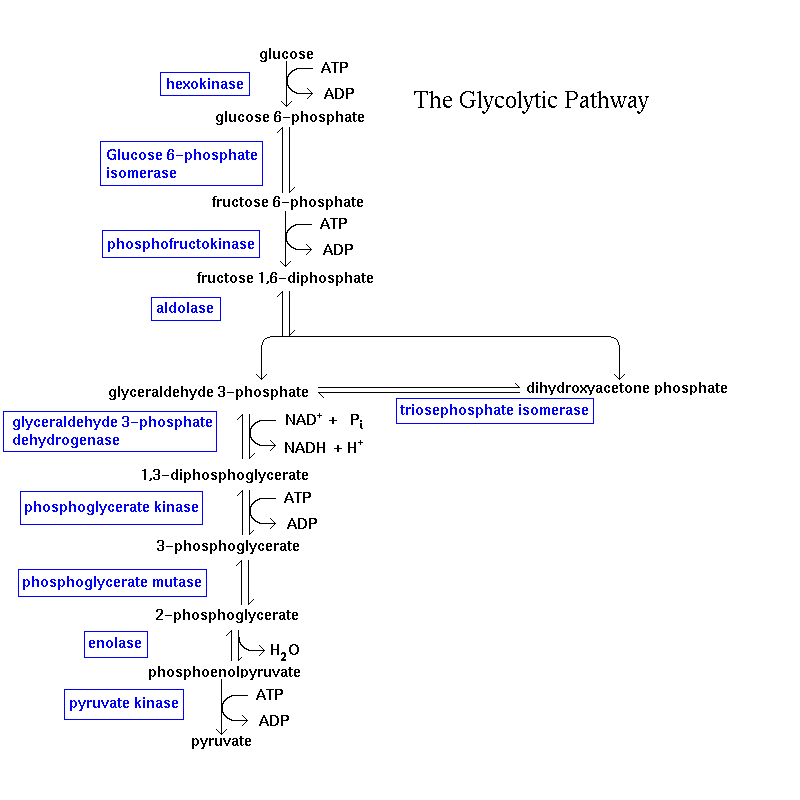
Glycolysis consists of two major phases:
(A) Preparatory phase and cleavage. (Steps 1-5)
(B) Oxidative and payoff phase. (Steps 6-10)
(A) Preparatory phase and cleavage:
It is the initial phase of glycolysis in which glucose molecule is activated by phosphorylation and then cleaved into two molecules of triose phosphates, namely 3-phosphoglyceraldehyde (3-C) or 3-PGAL and dihydroxy acetone phosphate (3-C) or DHAP.
In the next step only 3-PGAL participates and therefore DHAP gets converted into 3-PGAL.
Thus, at the end of this step two molecules of 3-PGAL are formed.
It includes following reactions.
1. Phosphorylation: I
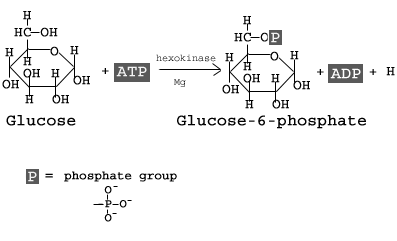
Glucose (6-C) molecule undergoes phosphorylation with the help of ATP.
It occurs in presence of the enzyme hexokinase and the co-factor Mg++.
In this reaction, one phosphate group from ATP is removed to produce glucose 6-phosphate (6-C) and ADP.
The third phosphate group of ATP gets attached to sixth carbon of glucose.
2. Isomerisation:
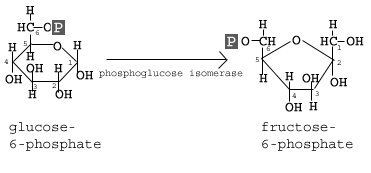
Glucose 6-phosphate (6-C) is converted into its isomer namely fructose 6-phosphate (6-C).
It occurs in presence of the enzyme phospho-gluco-isomerase.
3. Phosphorylation - II
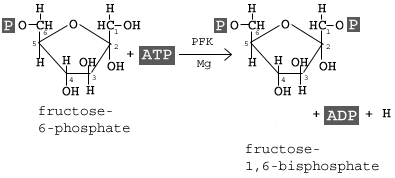
During this reaction, fructose 6-phosphate (6-C) is further phosphorylated by ATP molecule to give fructose 1, 6-diphosphate (6-C) and ADP.
Thus second phosphorylation takes place and phosphate group is attached to the first carbon.
This reaction is catalyzed by the enzyme phosphofructokinase [PFK]
4. Cleavage:
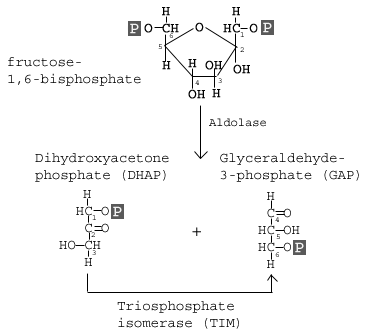
Fructose 1, 6-diphosphate (6-C) molecule splitsup into two molecules of triose phosphates.
These are known as 3-phosphoglyceraldehyde or 3-PGAL (3-C) and dihydroxy-acetone phosphate or DHAP (3-C).
This reaction is called cleavage and occurs in presence of the enzyme aldolase.
5. Isomerisation:
The triose phosphates, namely 3-PGAL and DHAP are isomers of each other and are interconvertable.
DHAP is converted into 3-PGAL, with the help of enzyme, phospho-triose-isomerase. Thus respiratory substrate is now in the form of 2 molecules of 3-PGAL.
(B) Oxidative and pay off phase:
During this phase oxidation by removal of hydrogen takes place and then there is ATP generation.(Harvest of energy)
6. Oxidation and phosphorylation:
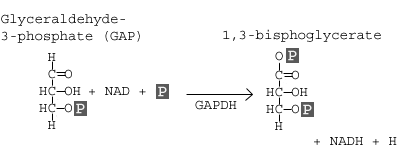
In presence of the enzyme phospho glyceraldehyde dehydrogenase [GAPDH], 3-PGAL undergoes dehydrogenation (oxidation).
Simultaneously, it undergoes phosphorylation, i.e. inorganic phosphate (Pi) gets incorporated, to give 1, 3- di-phospho glyceric acid (1, 3-diPGA).
During this reaction the coenzyme NAD (Nicotinamide Adenine Dinucleotide) takes up H2 and gets reduced to NADH2.
7. ATP Generation -I
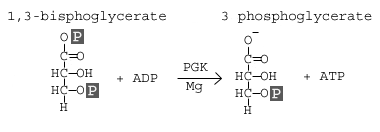
1, 3-diphosphogIyceric acid is converted into 3-phospho-glyceric acid (3-PGA) by removal of a phosphate group.
This phosphate combines with ADP to produce an ATP molecule.
The reaction takes place in presence of the enzyme phosphoglycerokinase [PGK].
8. Isomerisation
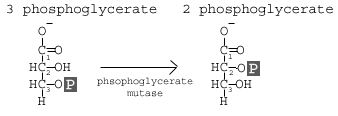
The enzyme phospho-glycero-mutase brings about the conversion of 3-PGA (3-C) into its isomer 2-PGA (3-C).
In this reaction the phosphate group is shifted from the third carbon atom to the second carbon.
9. Dehydration
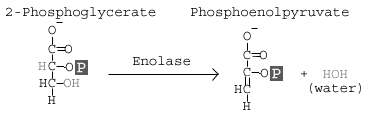
2-PGA undergoes dehydration and phosphoenol pyruvic acid or PEPA (3-C) is formed.
The enzyme enolase catalyzes the reaction in presence Mg++ as cofactor. One water molecule is released.
10. ATP Generation - II
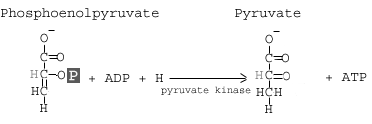
On hydrolysis, phospho-enol pyruvic acid loses a phosphate group (dephosphorylation) and gives pyruvic acid or pyruvate (3-C).
The released phosphate group combines with ADP and ATP generation takes place in presence of the enzyme pyruvate kinase.
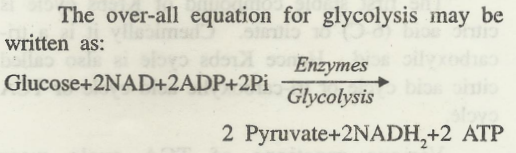
Summary of Glycolysis
One glucose molecule is converted into two molecules of pyruvate at the end of glycolysis.
Each reaction in the oxidative and pay off phase (from step 6 to step 10 above) occurs twice (there are two PGAL molecules).
Therefore, 2 ATP molecules are generated at step 7 and 2 more ATP molecules at step 10, in all it produces four molecules of ATP.
Two molecules of NADH, are produced at step 6.