Exercise
3.Answer the following questions
A. What are building blocks of life?
B. Explain the peptide bond.
C. How many types of polysaccharides you know?
D. Enlist the significance of carbohydrates.
E. What is reducing sugar?
F. What is the basic difference between saturated and unsaturated fatty acid?
G. Enlist the examples of simple protein and add their significance.
H. Explain the secondary structure of protein with examples.
I. Explain the induced fit model for mode of enzyme action.
J. What is RNA? Enlist types of RNA.
K. Describe the concept of metabolic pool.
L. How do secondary metabolites useful for mankind?
4. Solve the following questions
A. Match the correct pair.
B. Answer the questions with reference to the following figure.
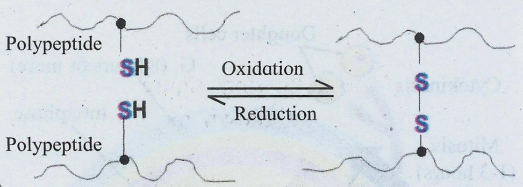
i. Name the type of bond formed between two polypeptides.
ii. Which amino acid is involved in the formation of such bond?
iii. Amongst I, II, III and IV structural level of protein, which level of structure includes such bond?
C. Match the following items given in column I and II.
5. Long answer questions
A. What are biomolecules? Explain the building blocks of life.
B. Explain the classes of carbohydrates with examples.
C. Describe the types of lipids and mention their biological significance.
D. Explain the chemical nature, structure and role of phospholipids in biological membrane.
E. Describe classes of proteins with their importance.
F. What are enzymes? How are they classified? Mention example of each class.
G. Explain the properties of enzyme? Describe the models for enzyme actions.
H. Describe the factors affecting enzyme action.
I. What are nucleic acids? Enlist the point of differences among DNA and RNA.
J. What are the types of RNA? Mention the role of each class of RNA.
K. What is metabolism? How metabolic pool is formed in the cell.
6. If double stranded DNA has 14% C (cytosine) what percent A (adenine), T (thymine) and G (gaunine) would you expect?
7. Name
i. The term that describes all the chemical reactions taking place in an organism.
ii. The form in which carbohydrate is transported in a plant.
iii. The reagent used for testing for reducing sugar.
Practical / Project :
1. Perform an experiment to study starch granules isolated from potato.
2. Study the action of enzyme urease on urea.
