Factors Affecting Enzyme Activity :
Following factors affect enzyme activity :
1. Concentration of Substrate :
Increase in the substrate concentration gradually increases the velocity of enzyme activity within the limited range of substrate levels. A rectangular hyperbola is obtained when velocity is plotted against the substrate concentration. Three distinct phases (A, B and C) of the reaction are observed in the graph.
Where
V= Measured velocity,
Vmax = Maximum velocity,
S = Substrate concentration,
Km = Michaelis-Menten constant.
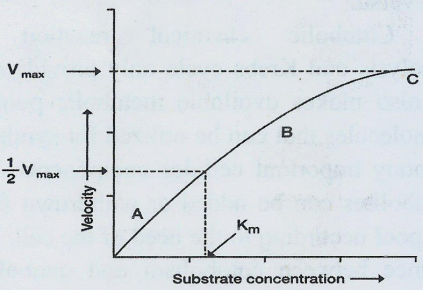
Effect of substrate concentration on enzyme activity
Km or the Michaelis-Menten constant is defined as the substrate concentration (expressed in moles/lit) to produce half of maximum velocity in an enzyme catalysed reaction. It indicates that half of the enzyme molecules (i.e. 50%) are bound with the substrate molecules when the substrate concentration equals the Km value.
Km value is a constant and a characteristic feature of a given enzyme. It is a representative for measuring the strength of ES complex. A low Km value indicates a strong affinity between enzyme and substrate, whereas a high Km value reflects a weak affinity between them. For majority of enzymes, the Km values are in the range of 10'5 to 10'2 moles.
2. Enzyme Concentration :
The rate of an enzymatic reaction is directly proportional to the concentration of the substrate. The rate of reaction is also directly proportional to the square root of the concentration of enzymes. It means that the rate of reaction also increases with the increasing concentration of enzyme. And the rate of reaction can also decreased by decreasing the concentration of enzyme.
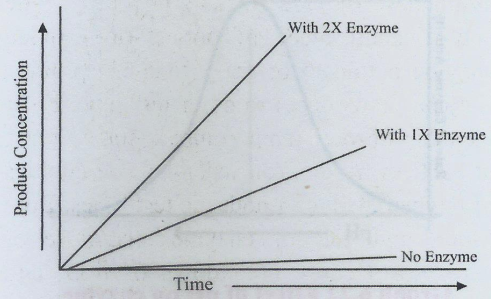 Effect of enzyme concentration
3. Temperature :
The enzymatic reaction occurs best at or around 37°C which is the average normal body temperature in homeotherms. The rate chemical reaction is increased by a rise in temperature but this is true only over a limited range of temperature. Enzymes rapidly denature at temperature above 40°C.
The activity of enzymes is reduced at low temperature. The temperature at which the enzymes show maximum activity is called Optimum temperature.
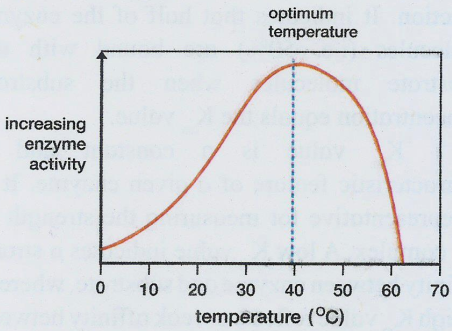 Effect of temperature on enzyme activity
4. Effect of pH :
Similar to temperature, there is also pH at which an enzyme will catalyze the reaction at the maximum rate.
Every enzyme has different optimum pH value. The enzyme cannot perform its function beyond the range of its pH value.
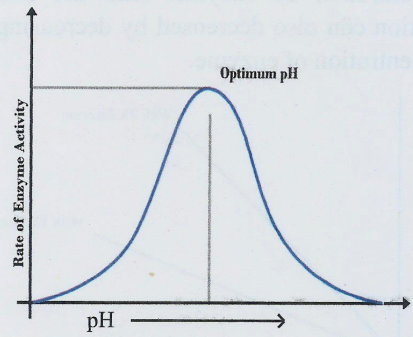 Effect of pH on enzyme activity
5. Other Substances :
The enzymes action is also increased or decreased in the presence of some other substances such as
1. co-enzymes - Most of the enzymes are combination of a co-enzyme and an apo-enzyme.
2. activators - Activators are the inorganic substances which increase the enzyme activity.
3. inhibitors - Inhibitor is the substance which reduces the enzyme activity.
