Concept of Metabolism:
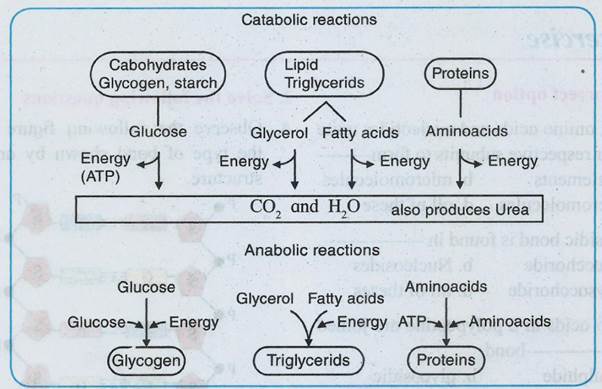
Metabolism is the sum of the chemical reactions that take place within each cell of a living organism and provide energy for vital processes and for synthesizing new organic material. It involves continuous process of breakdown and synthesis of biomolecules through chemical reactions, metabolic reaction results in a transformation of biomolecules, reactions do not occur in isolation but are always linked with some other reactions.
In living systems, cells are 'work centres' where metabolism involves two following types of pathways.
a. Catabolic pathways
It leads to formation of simpler structure from a complex biomolecules
e.g. when we eat wheat, bread or chapati, our gastrointestinal tract digests (hydrolyses) the starch to glucose units with help of enzymes and releases energy in form of ATP (Adenosine triphosphate).
b. Anabolic pathway
It is also called biosynthetic pathway that involves formation of a more complex biomolecules from a simpler structure,
e.g., synthesis of glycogen from glucose and protein from amino acids.
These pathways consume energy.
Metabolic pool :
It is the reservoir of biomolecules in the cell on which enzymes can act to produce useful products as per the need of the cell. The concept of metabolic pool is significant in cell biology because it allows one type of molecule to change into another type e.g. carbohydrates can be converted to fats and vice-versa.
Catabolic chemical reaction of glycolysis and Krebs cycle only provide ATP but also makes available metabolic pool of biomolecules that can be utilized for synthesis of many important cellular components. The metabolites can be added or withdrawn from this pool according to the need of the cell. The balance between catabolism and anabolism maintain homeostasis in the cell as well as in the whole body.