B. Lipids :
These are group of substances with greasy consistency with long hydrocarbon chain containing carbon, hydrogen and oxygen. In lipids, hydrogen to oxygen ratio is greater than 2:1 (in carbohydrates it is always 2:1).
Lipid is a broader term used for fatty acids and their derivatives. They are soluble in organic solvents (non-polar solvents).
Fatty acids are organic acids which are composed of hydrocarbon chain ending in carboxyl group (-COOH). They are of two types:
1. Saturated Fatty Acids are with no double bonds between the carbon atoms of the hydrocarbon chain. Palmitic and stearic acids found in all animal and plant fats are examples of saturated.

2. Satursaturated Fatty Acids are with one or more double bonds between the carbon atoms of the hydrocarbon chain. Oleic acid found in nearly all fats and linoleic acid found in many see oils are examples of unsaturated fatty acid.
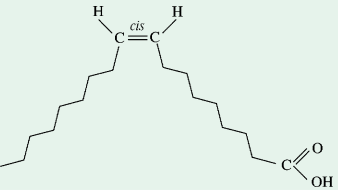
These fatty acids are basic molecules which form different kinds of lipids. Lipids may be classified as simple, compound and derived lipids.
Simple Lipids:
These are esters of fatty acids with various alcohols. Fats and waxes are simple lipids.
Fats are esters of fatty acids with glycerol (CH2OH-CHOH-CH2OH).
Triglycerides are three molecules of fatty acids and one molecule of glycerol.
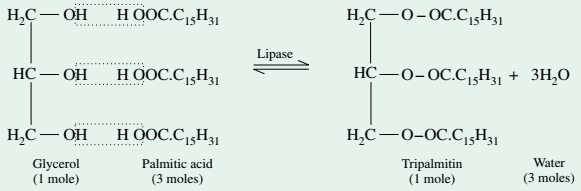
Generally, unsaturated fats are liquid at room temperature and are called oils.
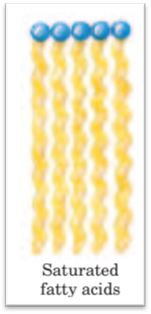
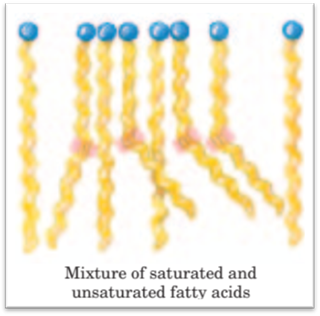
Unsaturated fatty acids are hydrogenated to produce fats e.g. Vanaspati ghee.
- Fats are a nutritional source with high calorific value.
- Fats act as reserved food materials.
- In plants it is stored in seeds to nourish embryo during germination.
- In animals fat is stored in the adipocytes of the adipose tissue.
- Fats deposited in subcutaneous tissue act as an insulator and minimise loss of body heat.
- Fats deposited around the internal organs act as cushions to absorb mechanical shocks.
- Wax is another example of simple lipid. They are esters of long chain fatty acids with long chain alcohols. They are most abundant in the blood, the gonads and the sebaceous glands of the skin. Waxes are not as readily hydrolysed as fats. They are solid at ordinary temperature.
- Waxes form water insoluble coating on hair and skin in animals, waxes form an outer coating on stems, leaves and fruits.
Compound lipids :
These are ester of fatty acids containing other groups like phosphate (Phospholipids), sugar (glycolipids), etc.
They contain a molecule of
- glycerol,
- two molecules of fatty acids and
- a phosphate group or simple sugar.
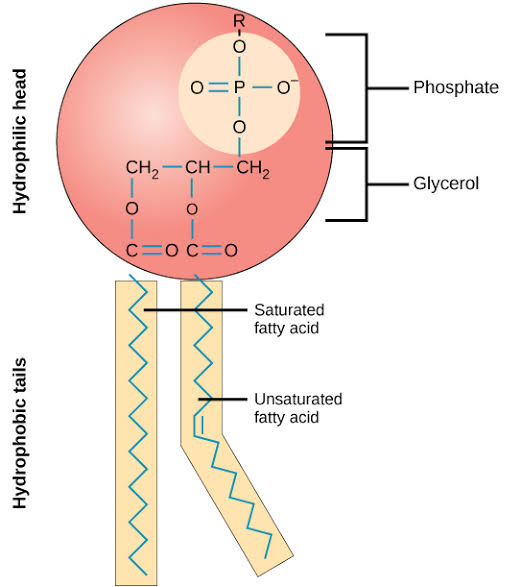
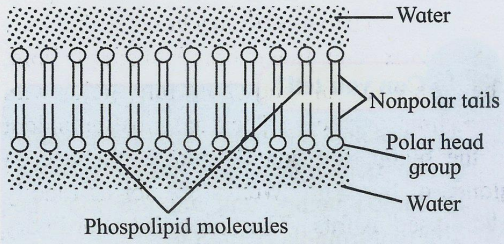
Some phospholipids such as lecithin also have a nitrogenous compound attached to the phosphate group. Phospholipids have both hydrophilic polar groups (phosphate and nitrogenous group) and hydrophobic non-polar groups (hydrocarbon chains of fatty acids). Phospholipids contribute in the formation of cell membrane.
Glycolipids contain glycerol, fatty acids, simple sugars such as galactose and nitrogenous base. They are also called cerebrosides. Large amounts of them have been found in the brain white matter and myelin sheath.
Sterols :
They are derived lipids. They are composed of fused hydrocarbon rings (steroid nucleus) and a long hydrocarbon side chain.
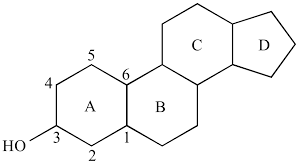
One of the most common sterol is cholesterol. It is widely distributed in all cells of the animal body, but particularly in nervous tissue. Cholesterol exists either free or as cholesterol ester.
Exercise - I
1. Why do high cholesterol level in the blood cause heart diseases?
2. Polyunsaturated fatty acids are believed to decrease blood cholesterol level. How?
Exercise - II
1. Differentiate between the saturated and unsaturated fats.
2. What are lipids? Classify them and give at least one example of each.
