Mechanism of enzyme action :
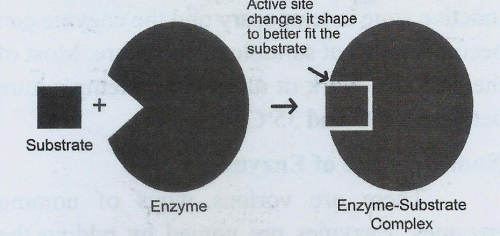
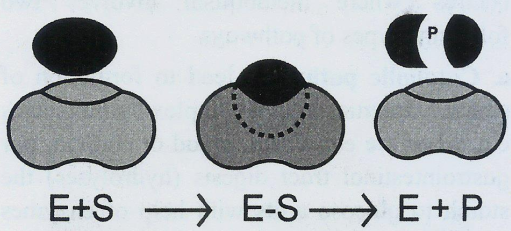
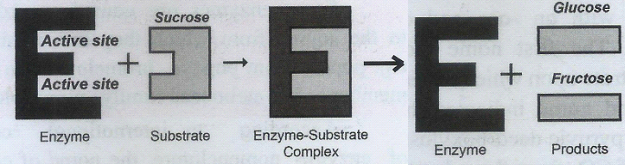
The basic mechanism by which enzymes catalyze chemical reactions begins with the binding of the substrate (or substrates) to the active site on the enzyme. The active site is the specific region of the enzyme which combines with the substrate. The binding of the substrate to the enzyme causes changes in the distribution of electrons in the chemical bonds of the substrate and ultimately causes the reactions that lead to the formation of products. The products are released from the enzyme surface to regenerate the enzyme for another reaction cycle. There are two models to explain the mechanism of forming Enzyme-Substrate complex, as described below:
Lock and Key model:
The specific action of an enzyme with a single substrate can be explained using a Lock and Key analogy first postulated in 1894 by Emil Fischer. In this analogy, the lock is the enzyme and the key is the substrate. Only the correctly sized key (substrate) fits into the key hole (active site) of the lock (enzyme).
Induced Fit model (Flexible Model):
Koshland (1959) proposed the induced fit theory, which states that approach of a substrate induces a conformational change in the enzyme. It is the more accepted model to understand mode of action of enzyme. Unlike the lock-and-key model, the induced fit model showsthatenzymesarerather flexiblestructures in which the active site continually reshapes by its interactions with the substrate until the time the substrate is completely bound to it (it is also the point at which the final form and shape of the enzyme is determined).