C. Proteins :
The term 'protein' (Gk. proteious meaning first or of primary importance) was suggested by Berzelius (1830). Mulder adopted the term protein to refer to the complex organic nitrogenous substances found in the cell of all animals and plants.
Characteristics :
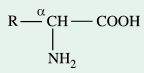
Proteins are large molecules containing amino acid units ranging from 100 to 3000. Proteins have high molecular weights. In proteins, amino acids are linked together by peptide bonds which join the carboxyl group of one amino acid residue to the amino group of another residue. A protein molecule consists of one or more polypeptide chains. Proteins can contain any or all of the 20 naturally occurring amino acid types.
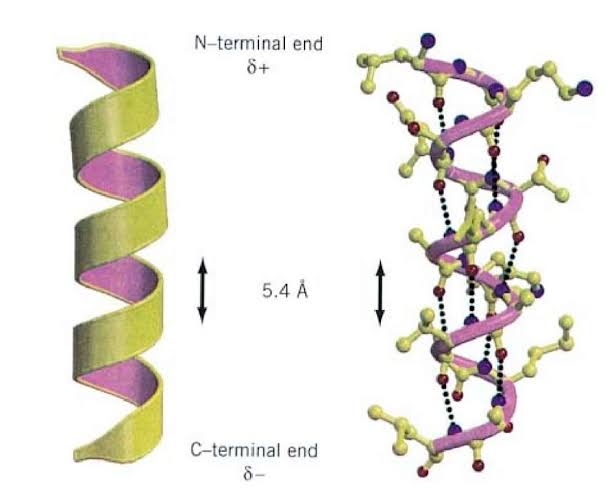
The linear sequence of amino acids in polypeptide ehain of a protein forms its primary structure. Functional proteins have 3-dimensional conformation. Some proteins such as keratin of hair consists of polypeptide chain arranged like a spiral helix.
Such spirals are in some cases right-handed called α-helix, in others left-handed called β-helix. The spiral configuration is held together by hydrogen bonds. The sequence of amino acids in the polypeptide chain also determines the location of its bend or fold and the position of formation of hydrogen bonds between different portions of the chain or between different chains. Due to formation of hydrogen bonds peptide chains assume a secondary structure.
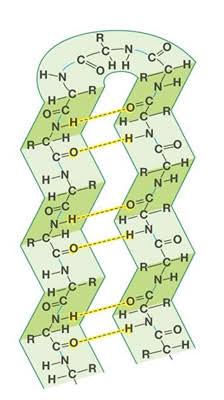
In some proteins, two or more peptide chains are linked together by intermolecular hydrogen bonds. Such structures are called β-pleated sheet. Pleated sheet structure is bound in protein of silk fibres.
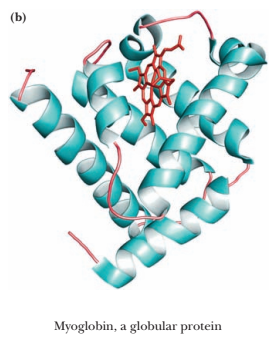
In large proteins such as myoglobin and enzymes, peptide chains are much looped, twisted and folded back on themselves due to formation of disulphide bonds. Such loops and bends give the protein a tertiary structure. Whereas in haemoglobin, protein subunits are held together to form quaternary structure.
Proteins are extremely reactive and highly specific in behaviour. Proteins are amphoteric in nature i.e. they act as both acids and bases. The behaviour of proteins is strongly influenced by pH.
Like amino acids, proteins are dipolar ions at the isoelectric point i.e. the sum of the positive charges is equal to the sum of the negative charges and the net charge is zero. The ionic groups of a protein are contributed by the side chains of the polyvalent amino acids.
A protein consists of more basic amino acids such as lysine and arginine exists as a cation and behaves as a base at the physiological pH of 7.4. Such proteins are called basic proteins. Histones of nucleoproteins are basic proteins.
A protein rich in acidic amino acids exists as an anion and behaves as an acid. Such proteins are called acidic proteins. Most of the blood proteins are acidic proteins.
Classification of proteins :
On the basis of structure, proteins are classified into three categories:
1. Simple proteins:
Simple proteins on hydrolysis yield only amino acids. These are soluble in one or more solvents. Simple proteins may be soluble in water.
Histones of nucleoproteins are soluble in water. Globular molecules of histones are not coagulated by heat.
Albumins are also soluble in water but they get coagulated on heating. Albumins are widely distributed e.g. egg albumin, serum albumin and legumelin of pulses are albumins.
2. Conjugated proteins :
Conjugated proteins consist of a simple protein united with some non-protein substance.
The non-protein group is called prosthetic group e.g. haemoglobin. Globin is the protein and the iron containing pigment haem is the prosthetic group.
Similarly, nucleoproteins have nucleic acids as prosthetic group.
On this basis, proteins are classified as glycoproteins and mucoproteins.
Mucoproteins are carbohydrate-protein complexes e.g. mucin of saliva and heparin of blood.
Lipopoteins are lipid-protein complexes e.g. conjugate protein found in brain, plasma membrane, milk etc.
Derived proteins:
These proteins are not found in nature as such. These proteins are derived from native protein molecules on hydrolysis. Metaproteins, peptones are derived proteins.
Exercise
1. All proteins are made up of the same amino acids; then how proteins found in human beings and animals may be different from those of other?
2. What are conjugated proteins? How do they differ from simple ones? Give one example of each.
3. Which of the following is a simple protein
- nucleoprotein
- mucoprotein
- chromoprotein
- globulin
