9.2 Morphology
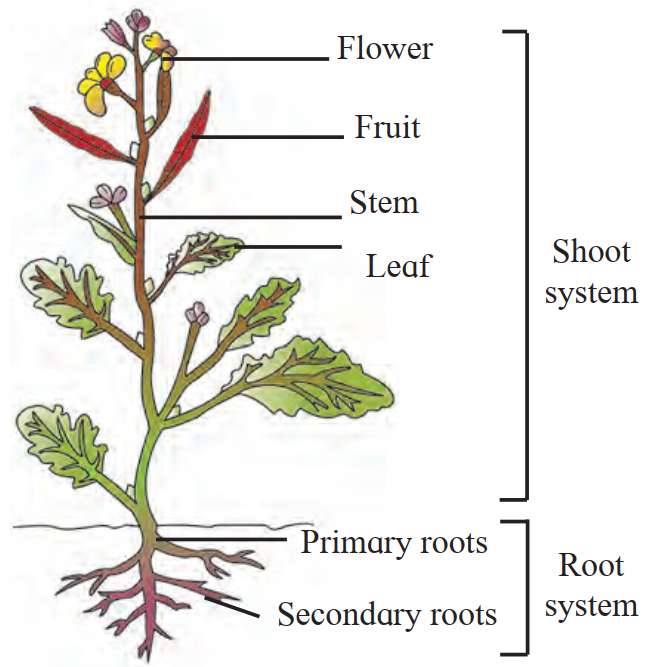
Plants show two types of structures:
- Vegetative structures: Root, stem, leaf
- Reproductive structures: Flowers, fruits, seeds
A. Root
Definition and Characteristics
Root is the descending axis of the plant body.
It has the following properties:
-
Positively geotropic (grows toward gravity)
- Hydrotropic(grows toward water)
- Negatively phototropic
(grows away from light)
- Negatively aerotropic(grows away from air)
-
Generally non-green, cylindrical, and without nodes and internodes
Regions of the Root Apex: A typical root consists of different regions, from top to bottom:
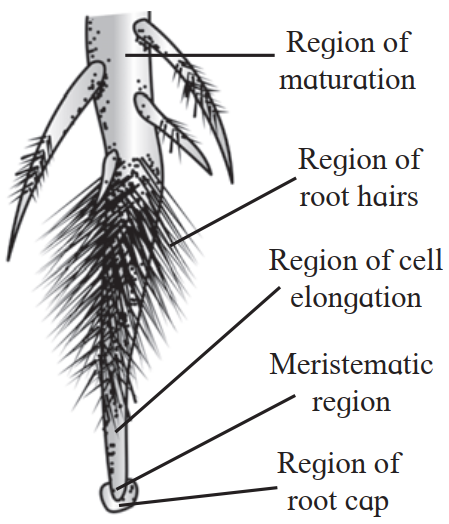
1. Region of Root Cap
-
A parenchymatous multicellular structure shaped like a cap at the young growing root apex
- Functions:
-
Cells secrete mucilage for lubricating the passage of root through soil
-
Cells contain starch granules that help in graviperception and geotropic movement
-
Note: Usually single root cap is present, but in Pandanus (screw pine), multiple root caps are present
-
In hydrophytes like Pistia and Eichhornia, root caps are replaced by root pockets
- Due to root cap, the growing apex is subterminal in position
2. Meristematic Region (Region of Cell Division)
- About 1 mm in length
- Protected by the root cap
-
Contains compactly arranged, thin-walled, actively dividing meristematic cells
- Function: Brings about longitudinal growth of root
3. Region of Elongation
-
Located just above the zone of cell division
- Cells are newly formed and show rapid elongation
- Function: Increases length of the root and helps in absorption of mineral salts
4. Region of Root Hairs (Absorption/Piliferous Zone)
- Made up of numerous hair-like outgrowths
-
Epiblema or piliferous layer produces tubular, elongated, unicellular structures called root hairs
- Characteristics:
- In close contact with soil particles
- Increase surface area for absorption of water
- Short-lived (ephemeral)
- Replaced every 10 to 15 days
5. Region of Cell Maturation (Differentiation)
- The major portion of root
-
Cells are quite impermeable to water due to thick-walled nature
-
Cells show differentiation and form different types of tissues
- Functions:
- Fixation of plant in soil
- Conduction of absorbed substances
- Development of lateral roots
Types of Root (Based on Origin)
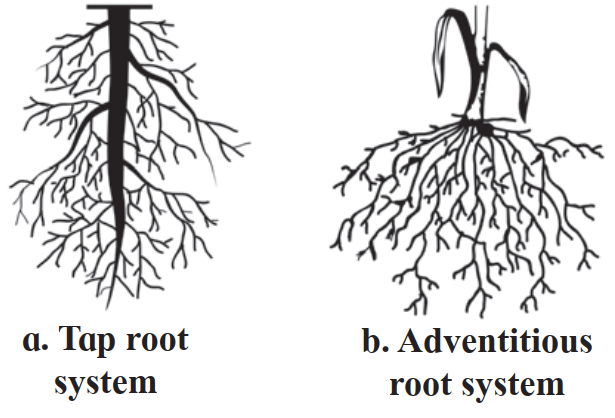
a. Tap Root (True Root)
-
Develops from the radicle of an embryo during seed germination
- Components:
- Primary root: The main root
- Secondary roots: Branches of first order
- Tertiary roots: Branches of second order
- Examples: Pea, Bean, Sunflower
- Common in dicotyledonous plants
b. Adventitious Roots
- Develops from any part other than the radicle
- May arise from:
- Base of the stem
- Nodes
- Leaves
- In monocots:
- Radicle is short-lived
-
From the base of stem, a thick cluster of equal-sized roots arises (fibrous root system)
- Roots look like thin fibers
- Growth is superficial
- Examples: Maize, Wheat, Sugarcane
-
Used for vegetative propagation in: Euphorbia, Carapichea ipecacuanha (Ipecac)
Modifications of Root
When roots perform special functions beyond their normal role, they develop structural changes called metamorphosed roots.
Modifications of Tap Root (Food Storage)
When tap roots store food, they become swollen, fleshy, and develop definite shapes:
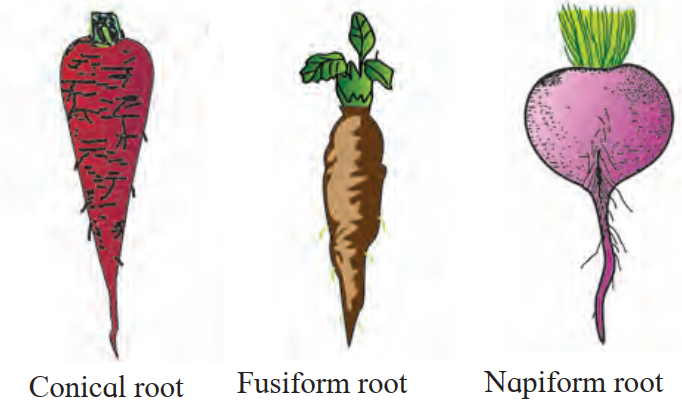
Fusiform
- Swollen in the middle and tapering toward both ends
- Spindle-shaped structure
- Example: Radish (Raphanus sativus)
Conical
- Broad at morphological base
- Narrows down toward apex
- Example: Carrot (Daucus carota)
Napiform
- Base is highly swollen and almost spherical
- Abruptly narrows toward apex
- Example: Beet (Beta vulgaris)
Modifications of Adventitious Roots (Food Storage)
Fibrous roots also show food storage but without definite shape.
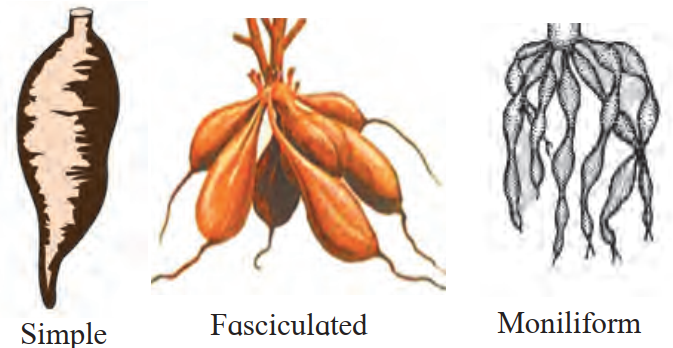
Simple Tuberous Roots
- Swollen but without definite shape
- Produced singly from nodes on stem
- Example: Sweet potato/Shakarkand (Ipomoea batatas)
Fasciculated Tuberous Roots
- Cluster of roots arising from one point
- Become thick and fleshy due to food storage
- Seen at the base of stem
- Examples: Dahlia, Asparagus
Beaded (Moniliform) Roots
- Show swellings at regular intervals like beads on a necklace
- Example: Spinacia oleracea (Indian Spinach)
Nodulose Roots
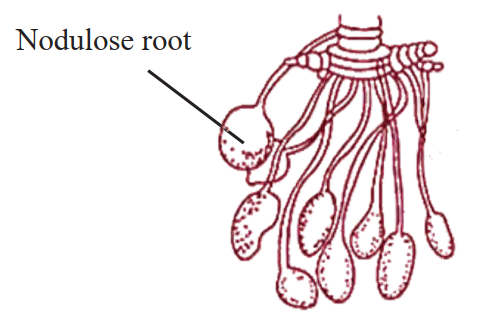
- Cluster of long, slender roots
- Become enlarged at the tips forming nodules
-
Examples: Arrow (Maranta root), Amhaldi (Curcuma amada)
Modifications for Respiration (Pneumatophores or Respiratory Roots)
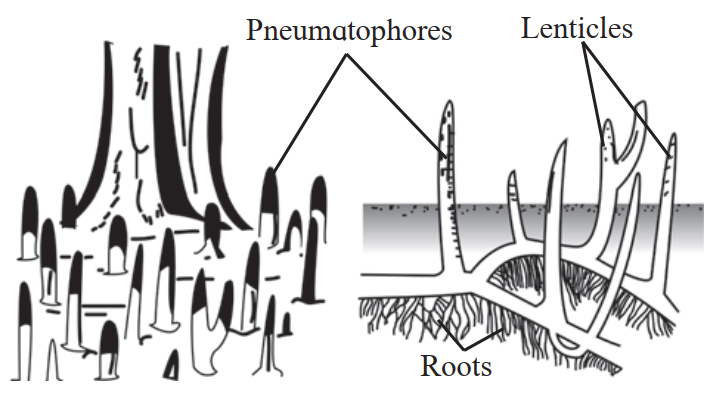
-
Found in halophytes (plants growing in saline swamps, marshy places, salt lakes)
- Problem: Main root system doesn't get sufficient air as soil is waterlogged, affecting mineral absorption
-
Solution: Underground roots develop special roots that are negatively geotropic, growing vertically upwards
- Structure: Conical projections present around main trunk
-
Features: Possess lenticels (minute pores for gaseous exchange)
- Examples:Rhizophora,
Avicennia,Sonneratia,
Heritiera(var. sundri)
Modifications for Mechanical Support
Prop Roots/Columnar Roots
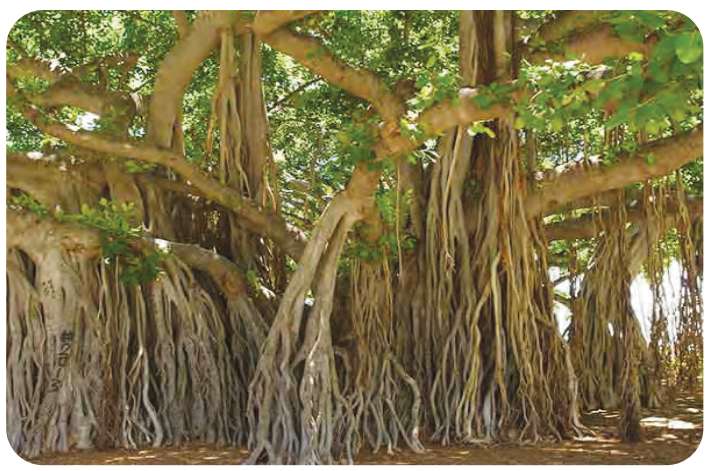
- Arise from horizontal branches of trees like
Ficus benghalensis(Banyan)
- Grow vertically downwards until they penetrate the soil
- Show secondary growth and become thick
- Act like pillars to support heavy branches
Stilt Roots
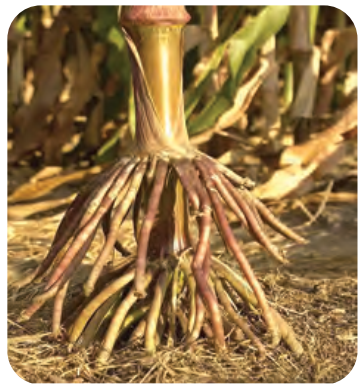
- Arise from lower nodes of weak stems in monocots, shrubs, and small trees
- Show obliquely downward growth penetrating soil
- Provide mechanical support
-
In Poaceae family: Maize, Jowar,Sugarcane produce stilt roots in whorls around nodes
-
In Pandanus (Screwpine/Kewada): Arise from lower surface of obliquely growing stem with multiple root caps
Climbing Roots
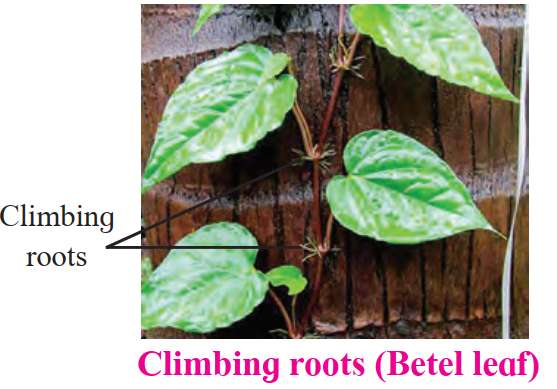
- Produced at nodes of weak-stemmed climbers
- Enable plants to attach to support and grow upward
- Examples: Betel leaf (Pan), Black pepper (Piper nigrum/Kali Mirch), Pothos (Money plant)
Clinging Roots
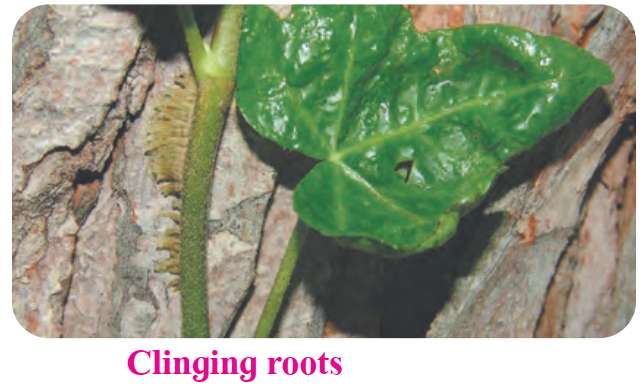
- Tiny roots developing along internodes
- Possess disc at tips that exude sticky substance
- Allow plant to attach to walls without damaging them
- Example: English Ivy (Hedera helix)
Plank Roots/Buttresses
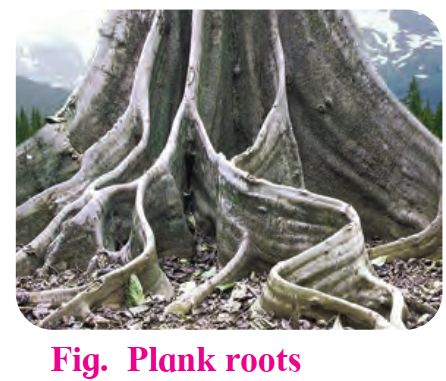
- Develop at the base of large trees
- Form plank-like extensions around stem
- Examples: Silk cotton, Pipal
Modifications for Special Functions
Epiphytic Roots
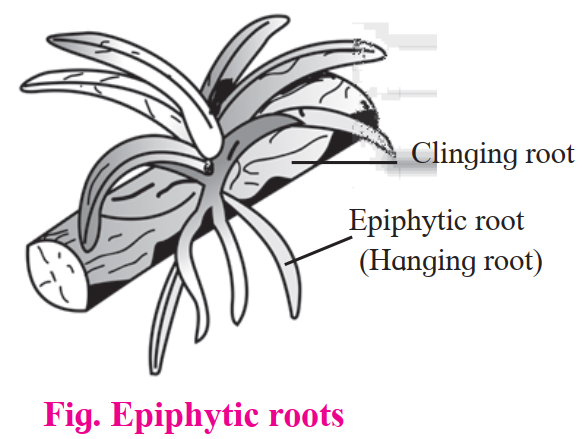
- Found in small epiphytic plants like orchids growing on tree branches in dense rain forests
- Problem: Unable to obtain soil moisture
- Solution: Produce specialized roots hanging in air
-
Features: Provided with spongy membranous absorbent covering (velamen tissue)
- Cells of velamen absorb moisture from air
- Velamen tissue is hygroscopic with porous walls
- Roots may be silvery white or green but without root cap
- Examples:
Vanda,Dendrobium
Sucking Roots or Haustoria
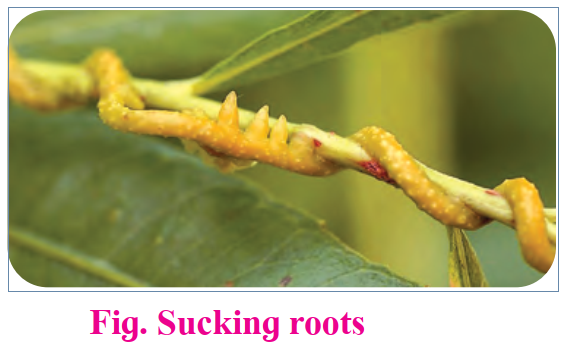
- Specialized microscopic sucking roots developed by parasitic plants
- Function: Absorb nourishment from host plant
Viscum album(Partial parasite):
- Develops haustoria that penetrate into xylem of host plant
- Absorbs water and nutrients
Cuscuta reflexa(Dodder/Amarvel) (Total parasite):
- Haustoria penetrate vascular strands
- Suck food from phloem, water and minerals from xylem
- Leafless plant with yellow stem
Buoyant Roots
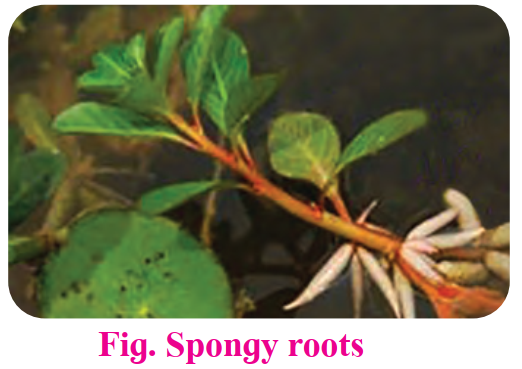
- Develop at nodes of aquatic herbs like Jussiaea repens
- Become highly inflated and spongy
- Provide buoyancy and help plant float
Root Modifications -
|
Category of Modification |
Type of Root |
Structural Features |
Primary Function |
Examples |
|
FOOD STORAGE (TAP ROOT) |
Fusiform |
Swollen in middle, tapers toward both ends; spindle-shaped |
Food storage |
Radish (Raphanus sativus) |
|
Conical |
Broad at base, narrows toward apex |
Food storage |
Carrot (Daucus carota) |
|
|
Napiform |
Highly swollen spherical base, abruptly narrows toward apex |
Food storage |
Beet (Beta vulgaris) |
|
|
FOOD STORAGE (ADVENTITIOUS ROOT) |
Simple Tuberous |
Swollen without definite shape; single from nodes |
Food storage |
Sweet Potato (Ipomoea batatas) |
|
Fasciculated Tuberous |
Cluster of thick, fleshy roots from one point; at stem base |
Food storage |
Dahlia, Asparagus |
|
|
Beaded/Moniliform |
Swellings at regular intervals like beads on necklace |
Food storage |
Spinacia oleracea (Indian Spinach) |
|
|
Nodulose |
Long slender roots with enlargements at tips forming nodules |
Food storage |
Arrow (Maranta), Amhaldi (Curcuma amada) |
|
|
RESPIRATION |
Pneumatophores/Respiratory Roots |
Negatively geotropic, grow vertically upward; conical projections; possess lenticels for gas exchange |
Air respiration in waterlogged soil |
Rhizophora, Avicennia, Sonneratia, Heritiera (sundri) |
|
MECHANICAL SUPPORT |
Prop Roots |
Arise from horizontal branches; grow vertically downward; secondary growth; thick and pillar-like |
Support heavy branches |
Ficus benghalensis (Banyan) |
|
Stilt Roots |
Arise from lower nodes; oblique downward growth; in whorls or multiple arrangements |
Mechanical support of weak stems |
Maize, Jowar, Sugarcane (Poaceae); Pandanus (Screwpine) |
|
|
Climbing Roots |
Produced at nodes of weak-stemmed climbers; enable upward attachment |
Support and attachment for climbing |
Betel leaf (Piper betel), Black pepper (Piper nigrum), Pothos (Money plant) |
|
|
Clinging Roots |
Tiny roots at internodes; disc at tips with sticky substance; no damage to support |
Attachment to walls and surfaces |
English Ivy (Hedera helix) |
|
|
Plank Roots/Buttresses |
Develop at tree base; plank-like extensions around stem |
Support and stability of large trees |
Silk Cotton, Pipal |
|
|
SPECIAL FUNCTIONS |
Epiphytic Roots |
Hang in air; velamen tissue (spongy, hygroscopic); no root cap; silvery-white or green |
Absorb moisture from air |
Vanda, Dendrobium (Orchids) |
|
Sucking Roots/Haustoria |
Microscopic penetrating roots; partial or total parasites; penetrate vascular tissues |
Absorb nourishment from host plant |
Viscum album (Mistletoe); Cuscuta reflexa (Dodder/Amarvel) |
|
|
Buoyant Roots |
Develop at nodes; highly inflated and spongy |
Buoyancy; help plant float |
Jussiaea repens (Aquatic herb) |
